Tri-Cities / Benton County · 509
Bat removal in Kennewick, Washington
Kennewick sits on the west bank of the Columbia between the mouths of the Yakima and the Snake, and it is the largest of the Tri-Cities: Washington OFM puts its April 1, 2026 population at 89,220, up from 83,921 at the 2020 census. The Columbia shoreline, Columbia Park, irrigation canals and the orchards and vineyards on the edges of town put a lot of night-flying insects within reach of every neighborhood, and Benton County is one of the Washington counties where WDFW has confirmed white-nose syndrome in bats. Washington Wildlife Specialists handles Kennewick attic, wall, garage, shop and warehouse exclusions with an inspection first, one-way devices timed to WDFW guidance, permanent sealing, no poisons, and a two-year written warranty on whole-structure work.
Local housing & attic patterns in Kennewick
HistoryLink’s history of Kennewick explains why its houses vary so much block to block. The town started as a Northern Pacific construction camp in 1884, nearly emptied when the Columbia rail bridge was finished in 1887, revived with an irrigation project in 1892, and emptied again after the Panic of 1893. It took hold for good in 1902, when the railroad finished the irrigation system, and voters incorporated in 1904. Strawberries, asparagus, orchards and Concord grapes built a small farm town of 1,918 people by 1940. Then Hanford arrived in 1943 and Kennewick became a bedroom community for thousands of workers, quintupling to 10,106 by 1950; the Columbia Basin Irrigation Project and the 1970s nuclear-plant construction made it the largest of the Tri-Cities, at 34,397 people by 1980, and growth has continued since. So Kennewick has a few early-1900s frame houses and brick storefronts around Kennewick Avenue and downtown, a lot of 1940s–60s Hanford-era homes and ranches in the older central neighborhoods, 1970s–90s split-levels and ranches across west Kennewick, large 2000s–2020s two-story and stucco homes in Southridge, Canyon Lakes and the south hills, and metal warehouses, cold-storage and food-processing buildings, and orchard and vineyard shops on the edges of town. Older frame houses leak at gable vents, fascia corners, chimney flashing and where additions meet the original roof. Hanford-era and 1970s homes leak at soffit returns, attic-vent screens and garage tie-ins. Newer hillside homes leak at ridge-vent ends, J-channel, corner trim, stucco and cultured-stone transitions and tile-roof eaves, and metal buildings at ridge caps, eave closures, louvers and door tracks. WDFW notes bats can use an opening as small as half an inch, so we check the house, the garage and any shop on the lot.
Bat seasonality around Kennewick
WDFW says Washington bats move into hibernation sites in late September or October and stay until April or early May, and that pups are raised in nursery colonies starting around May. Kennewick’s hot, dry summers heat west- and south-facing attics, tile and metal roofs fast; colonies are largest and noisiest in July and August, when bats shift into cooler wall voids and young bats learning to fly sometimes end up inside. WDFW also says bats fly up to 6 miles from a roost to feed and that little brown and Yuma bats prefer to hunt over water, which puts every Kennewick neighborhood within reach of the Columbia, the Yakima delta or irrigated ground. One-way exclusion fits mid-August to mid-October, after the young can fly, or early spring before births. WDFW advises leaving bats found hibernating in a building after October 15 alone until spring, so a November or winter call in Kennewick usually means an inspection, sealing any routes into living space now, and scheduling the full exclusion for the next window.
Neighborhoods & landmarks we know
We work across Kennewick, ZIP codes 99336, 99337 and 99338: historic downtown and the Kennewick Avenue blocks, the older central neighborhoods around Kennewick High School, homes along the Columbia near Columbia Park and Clover Island, west Kennewick along Clearwater Avenue, 10th Avenue and the Columbia Center Boulevard retail area, the Highway 395 corridor, and the newer hillside neighborhoods in Southridge, Canyon Lakes and the south hills. We also cover warehouses, cold-storage and industrial buildings along the rail and Highway 240 corridors and orchard, vineyard and shop properties on the edges of town and into Finley. Pasco, Richland, West Richland and Benton City addresses run on the same route; call with the address to confirm scheduling.
Why hire a local eastern Washington crew
A 1910s house downtown, a 1950s Hanford-era ranch, a 2018 two-story in Southridge and a metal cold-storage building near the tracks each fail in different places, and we scope and price each one on its own. Tri-Cities heat, wind and dust break down cheap foam and caulk quickly, so we seal with exclusion-grade materials matched to the trim, siding, stucco or panel profile, never expanding spray foam. Tile and stucco hillside homes get detailing at weep screeds, roof-to-wall transitions and tile eave closures that a basic soffit job misses. For warehouses, packing and processing buildings and farm shops we plan around shifts, docks and harvest, use several one-way devices on large colonies, and photograph every sealed entry for owners, property managers and insurers. We time every exclusion to WDFW guidance and back whole-structure work with a two-year written warranty.
- Bat specialists since 2011 — bats are our flagship service
- Documented inspection: openings numbered, photographed, primary vs. secondary
- Targeted repair or whole-structure seal (warranty on whole-structure)
- Humane one-way exclusion · WDFW-aware timing (May–August maternity)
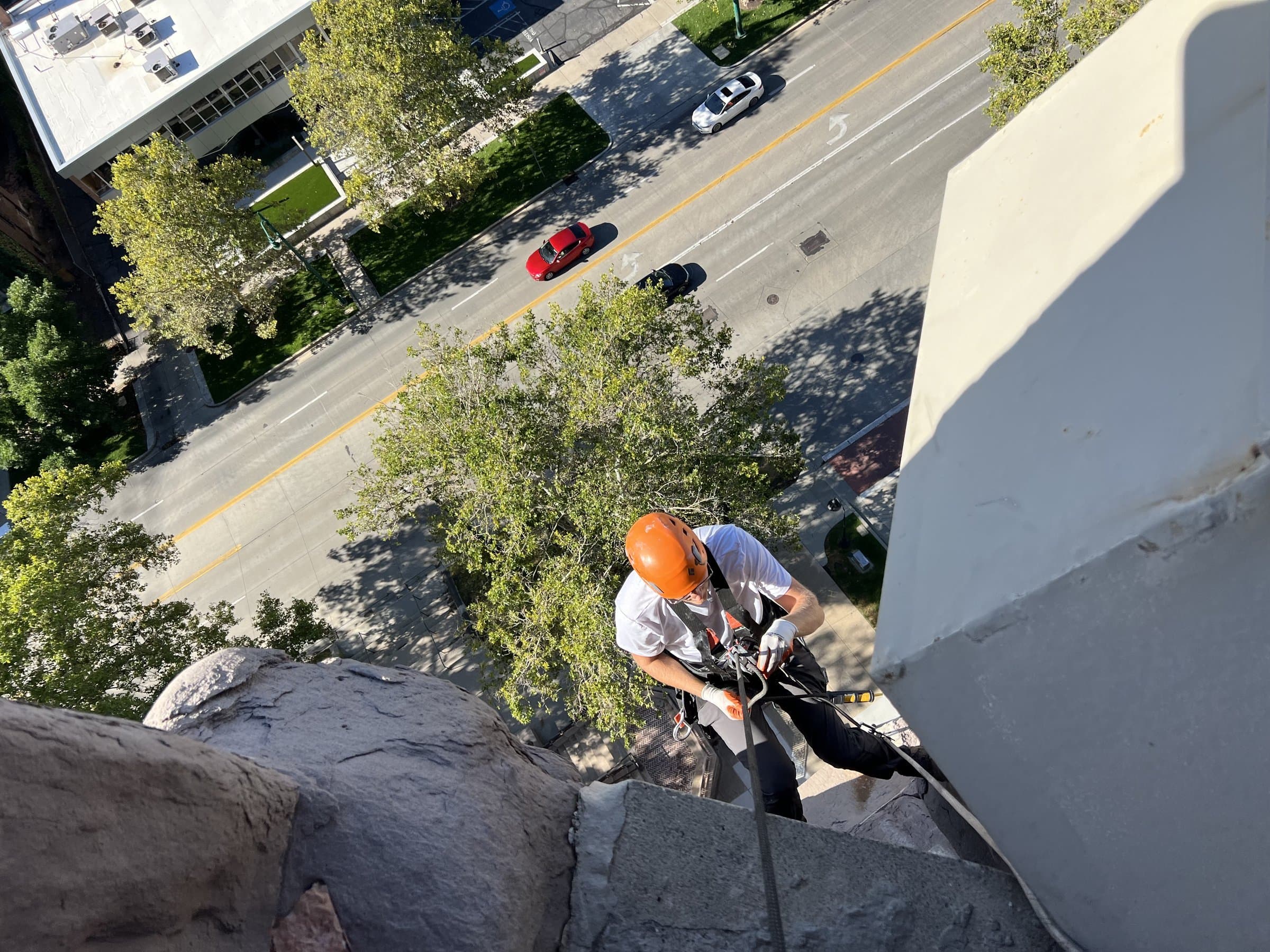
- High-rise / rope-access capacity for elevated buildings
- We finish failed prior jobs—remove old foam and devices
- Two-year written warranty on sealed whole-structure work
- Local eastern WA ownership, backed by a multi-state team
Typical Kennewick jobs start with a phone consultation, then an attic inspection, followed by humane exclusion and optional guano cleanup. Commercial properties can use our commercial bat removal program.
Local bat facts for Kennewick
HistoryLink records that Kennewick’s voters approved incorporation 53 to 3 in 1904, and that the city grew from 1,918 people in 1940 to 10,106 in 1950 as Hanford workers poured in. Washington OFM puts Kennewick at 89,220 people on April 1, 2026 (2020 census: 83,921). WDFW lists Benton County among the counties with confirmed white-nose syndrome in bats. Under WAC 220-200-100 bats are protected wildlife except when found in or immediately adjacent to a dwelling or other occupied building.
Who to call in Kennewick
- Bat in the house or any bat contact: Benton-Franklin Health District, 509-460-4205 (animal bites and exposures). Main office: 7102 W. Okanogan Place, Kennewick, 509-460-4200.
- Stray dogs and cats, distressed domestic animals: Tri-Cities Animal Services (Kennewick, Pasco, Richland), 1311 S. 18th Ave., Pasco, 509-545-3740, or non-emergency dispatch 509-628-0333. Overseen by the City of Kennewick’s Animal Control Authority. Domestic animals only, not bats in buildings.
- Law enforcement: Kennewick Police Department, 211 W. 6th Ave., business 509-585-4208; non-emergency 509-628-0333; 911 for emergencies.
- Wildlife questions: WDFW South Central Region 3 office, 1701 S. 24th Ave., Yakima, 509-575-2740 (serves Benton, Franklin, Kittitas and Yakima counties).
- City Hall: City of Kennewick, 210 W. 6th Ave., 509-585-4200.
- Bats living in the attic or walls: A private wildlife control operator. WDFW does not remove bats; it refers homeowners to nuisance wildlife control operators.
Sources
- Benton-Franklin Health District – Rabies
- Benton-Franklin Health District – Bats (office locations)
- City of Kennewick – Animal Control (Tri-Cities Animal Services)
- Kennewick Police Department – 2025 Annual Report (contacts)
- City of Pasco – Animal Services (Tri-Cities Animal Services)
- HistoryLink – Kennewick: Thumbnail History
- Tri-City Herald – Bat captured in Prosser house tests positive for rabies (May 2024)
- Washington State DOH – Bats tested for rabies by county, 2021–2025 (PDF)
- Washington State DOH – Rabies activity in Washington
- WDFW – White-nose syndrome in Washington
- WDFW – Regional offices (South Central Region 3)
- WDFW – Living with wildlife: Bats
- Washington OFM – April 1, 2026 population of cities, towns and counties
- WAC 220-200-100 – Wildlife classified as protected
Kennewick bat removal FAQ
Kennewick & the Tri-Cities
- Pasco bat removal
Tri-Cities / Franklin County
- Richland bat removal
Tri-Cities
- West Richland bat removal
Tri-Cities / Benton County
- Benton City bat removal
Lower Yakima Valley / Benton County
- Prosser bat removal
Lower Yakima Valley / Benton County
- Sunnyside bat removal
Lower Yakima Valley / Yakima County
- Moses Lake bat removal
Grant County / Columbia Basin
- Yakima bat removal
Yakima Valley
- Walla Walla bat removal
Walla Walla Valley / Walla Walla County
- College Place bat removal
Walla Walla Valley / Walla Walla County
- Spokane bat removal
Spokane metro
- All service areas
Eastern Washington hub
- Why us
Proof points & team
- How we work
Process steps
- Warranty
Two-year coverage
- FAQ
Common questions
Bat problems in Kennewick? Let's talk.
Humane exclusion for Kennewick and the surrounding Tri-Cities / Benton County. Two-year written warranty on whole-structure work. Same-day often available across the 509.