Service
Humane bat removal for homes in eastern Washington
Bats in an attic, wall or chimney are a common problem from Spokane and the Palouse to the Tri-Cities, Yakima Valley and Wenatchee, and they are not a job for a pest spray. WDFW counts fifteen bat species in Washington and says the ones most often seen around homes are the little brown bat, Yuma myotis, big brown bat, pallid bat and California myotis. All of them are protected wildlife, so the legal and lasting way to get them out is to let them leave on their own through one-way devices and then seal the building so they cannot come back. Washington Wildlife Specialists has done that work since 2011: inspection first, exclusion timed to WDFW’s seasonal windows, permanent sealing with no spray foam, optional guano cleanup, and a two-year written warranty on whole-structure work, with lifetime warranties available on request.
Signs you have bats, not mice or birds
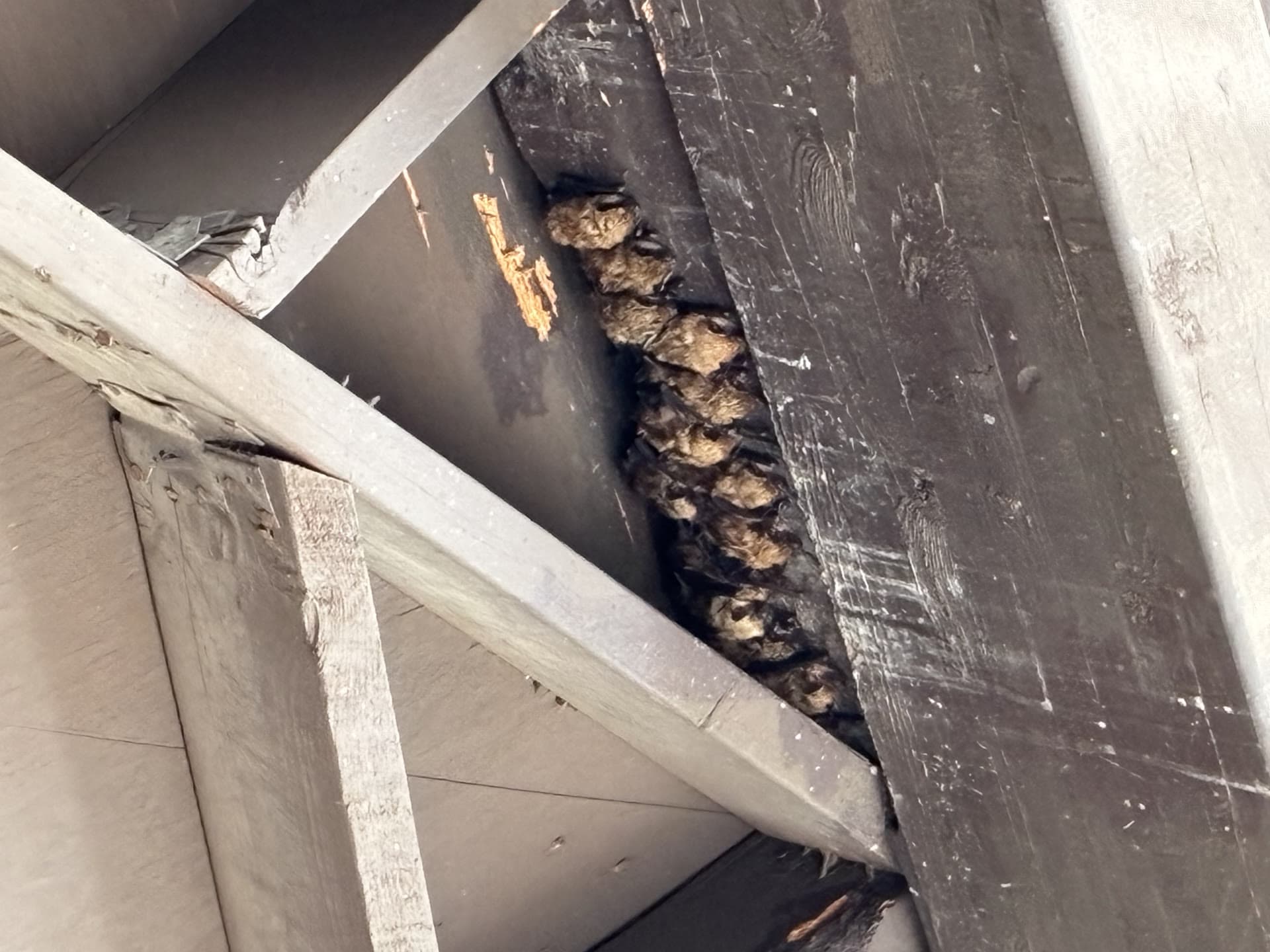
The usual clues are scratching or squeaking in the ceiling or a wall around sunset, dark rice-sized droppings stuck to siding or piled on a deck or windowsill, an ammonia smell in an upstairs room on hot afternoons, and bats seen leaving the roofline at dusk. WDFW notes that well-used openings get dark rub marks from bat body oils and that the exit is usually right above the droppings stuck to the wall. Bat droppings are dry and crumble into shiny insect pieces; mouse droppings are harder and scattered along travel routes. WDFW also points out that bats have small teeth for eating insects and do not chew holes, shred insulation for nests or gnaw wiring, so chewed material points to rodents or squirrels instead.
A bat inside the house: what to do before you call us
If a bat is in the living space, health comes before removal. Washington DOH says bats are the only known mammal to carry rabies in the state and that rabid bats have been found in almost every county; its 2026 rabies table lists 27 positive bats through September, including Spokane, Yakima, Chelan and Asotin counties. DOH’s advice is never to handle a bat with bare hands, to call your local health department so it can decide whether the bat should be tested, and to capture only a bat that had direct contact with a person or pet or was in a room where someone may have had contact, such as a sleeping person or a young child. If there was no possible contact, close interior doors, open a window and let it leave. Once the health question is handled, we find out how it got in.
Step 1: inspection and exit watch
Every removal starts with a full look at the building. WDFW lists the common entry points as chimneys and where masonry meets the house, joints around window frames, siding and large beams, building corners, roof edges, ridge caps, soffits and fascia boards, gable-end eave joints, pipe and wire penetrations, and the seams where porches or additions join the main house, and says an opening as small as ½ inch can be enough. We check all of those, look inside the attic when it can be entered safely, and when the season allows we watch the building at dusk to count bats and confirm which openings are in active use. You get the entry map and a written plan before any exclusion work starts.
Step 2: one-way exclusion on WDFW’s timing
Exclusion means fitting one-way devices over the active exits so bats can leave at night to feed but cannot get back in, while every other gap is sealed. Timing matters as much as hardware. WDFW says pups are raised in nursery colonies starting around May, and that disturbing a maternity colony while young cannot fly can leave pups abandoned or dropped; that is why we exclude from mid-August to mid-October, after the young can fly, or in early spring before births. WDFW also says bats move into hibernation sites in late September or October, that big brown bats can hibernate in buildings, and that bats found hibernating inside after October 15 should be left alone until spring while routes into living space are sealed. A winter call therefore means inspection and interior sealing now, with exclusion scheduled for the next window.
Step 3: permanent sealing that holds up in eastern Washington weather
Once the bats are out and activity has stopped, the devices come off and the exits are sealed permanently. Hot dry summers, cold winters, wind and dust in the 509 crack cheap caulk and break down foam within a few seasons, so we do not use spray foam. Small gaps get clear, paintable exterior sealant; larger gaps and metal-roof ribs get custom-cut inserts; vents and chimneys get screen, hardware cloth, flashing and caps; brick gets mortar repair where it is needed; and weep holes get proper covers instead of being sealed solid. Finished work is matched to the trim and siding so it is hard to see from the street.
Why DIY and pest-control shortcuts fail
Most call-backs we see start with one of three mistakes: sealing the holes while bats are still inside, which traps them in the attic or pushes them into the living space; blocking only the obvious opening, so the colony moves a few feet down the same roofline; or using foam and mesh that fails after a summer or two. Poisons are not an option: bats are protected wildlife under WAC 220-200-100, although bats in or right next to an occupied building may be removed without a permit, which is why humane one-way methods are the standard. WDFW itself does not remove bats from homes and refers homeowners to private wildlife control operators.
After the bats are out: droppings, odor and health
Small amounts of droppings can be cleaned up during sealing. Heavy deposits on insulation are a separate job: Washington DOH says large amounts of bird or bat droppings should be cleaned up by companies that specialize in it, and NIOSH recommends respiratory protection, gloves and disposable coveralls for work that disturbs accumulated droppings because of the fungus that causes histoplasmosis. Our guano cleanup service handles removal of contaminated insulation, sanitizing and odor treatment, and we schedule it after exclusion so the attic stays clean. White-nose syndrome is another reason we follow WDFW’s rules carefully; WDFW confirmed the disease in Washington in 2016 and has since confirmed it in counties including Benton, Chelan and Kittitas.
Homes we work on across the 509
We remove bats from older bungalows and brick homes in Spokane, Walla Walla and Yakima, mid-century ranches in the Tri-Cities and Moses Lake, newer subdivisions in Spokane Valley, Liberty Lake, West Richland and East Wenatchee, farmhouses and shops across the Yakima Valley and the Palouse, plus rentals, cabins and multifamily buildings. Each building leaks in different places, from gable vents and chimney flashing on older houses to soffit returns, garage tie-ins and ridge vents on newer ones, so every job is scoped and priced on its own. Commercial buildings, schools and churches are covered on our commercial bat removal page.
Serving Spokane and eastern Washington—including Spokane, Kennewick, and Yakima. Start with an attic inspection if you are unsure what is in the structure.
Sources
- WDFW – Living with wildlife: Bats
- WDFW – White-nose syndrome in Washington
- WDFW – Hiring a Wildlife Control Operator
- Washington State DOH – Rabies
- Washington State DOH – Rabies activity in Washington (2026)
- Washington State DOH – Histoplasmosis
- CDC/NIOSH – Histoplasmosis: personal protective equipment
- WAC 220-200-100 – Wildlife classified as protected
Bat Removal FAQ
Related services
- Bat Exclusion
Professional bat exclusion for Spokane, Tri-Cities, Yakima and Wenatchee homes and buildings: full entry mappi…
- Guano Cleanup
Bat guano cleanup for eastern Washington attics, walls and commercial buildings: wet or HEPA removal under con…
- Attic Inspection
Bat inspections for eastern Washington homes and buildings: attic and roofline check, dusk exit watch, entry-p…
- Commercial Bat Removal
Commercial bat removal for schools, churches, warehouses, packing and cold-storage buildings, multifamily and …
Bat education guides
- Bat guides hub
Signs, species, attic roosts, maternity timing, damage, and exclusion explained for eastern WA.
- Signs of bats
Guano, odor, dusk fly-outs, and grease marks on Spokane-area homes.
- How exclusion works
One-way devices, sealing sequence, and why DIY fails.
- Bat damage & health risks
Guano, odor, insulation and what WA DOH says about rabies and histoplasmosis.
Bat removal by city
- Spokane bat removal
Local Spokane housing patterns, seasonality, and CTAs.
- Spokane Valley bat removal
Local Spokane Valley housing patterns, seasonality, and CTAs.
- Liberty Lake bat removal
Local Liberty Lake housing patterns, seasonality, and CTAs.
- Cheney bat removal
Local Cheney housing patterns, seasonality, and CTAs.
- Airway Heights bat removal
Local Airway Heights housing patterns, seasonality, and CTAs.
- Kennewick bat removal
Local Kennewick housing patterns, seasonality, and CTAs.
- All service areas
Full eastern Washington coverage map and city list.
Talk through bat removal for your building
Serving Spokane, Spokane Valley, Liberty Lake, Cheney, Airway Heights, Moses Lake, the Tri-Cities (Kennewick, Pasco, Richland, West Richland), Yakima, Selah, Moxee, Union Gap, Wapato, Zillah, Toppenish, Wenatchee, East Wenatchee, Pullman, Clarkston, Walla Walla, College Place, Ellensburg, Sunnyside, Grandview, Prosser, Benton City, Medical Lake, Deer Park, Ephrata, and Millwood. Same-day available across the 509. Humane, WDFW-aware exclusion with a two-year written warranty.