
Spokane metro · 509
Bat removal in Spokane, Washington
Spokane is the largest city in eastern Washington, built where the Spokane River drops through a basalt gorge in the middle of downtown, and Washington OFM puts its April 1, 2026 population at 235,900 (2020 census: 228,989). The river corridor, the Olmsted-era park system, Latah (Hangman) Creek, the pine bluffs of the South Hill and Five Mile, and the Little Spokane River on the north edge give bats water and insects within a short flight of almost every neighborhood. Washington DOH’s 2026 rabies table lists two rabid bats collected in Spokane County in July 2026, and Spokane Regional Health District asks residents to report any bat found inside a home. Washington Wildlife Specialists handles Spokane attic, wall, chimney, garage and commercial exclusions with an inspection first, one-way devices timed to WDFW guidance, permanent sealing, no poisons, and a two-year written warranty on whole-structure work.
Local housing & attic patterns in Spokane
HistoryLink’s thumbnail history of Spokane explains why the city’s buildings fail where they do. Spokane incorporated in 1881 with about 1,000 people; the Great Fire of August 4, 1889 destroyed 32 blocks, virtually the entire downtown, and the city rebuilt in brick and stone under architects like Kirtland Cutter. Between 1900 and 1910 the population jumped from almost 40,000 to more than 100,000. Wealthy families built in Browne’s Addition west of downtown and on the basalt heights of the South Hill, where the Olmsted Brothers advised on parks and boulevards, while working families settled north of the river. The City–County Historic Preservation Office lists Browne’s Addition (National Register, 1976), Corbin Park (1992) and Rockwood (1997) among Spokane’s historic districts. So Spokane has a deep stock of 1890s–1920s houses: Queen Anne and Colonial Revival homes in Browne’s Addition, Craftsman bungalows, foursquares and brick Tudors on the South Hill and around Manito, and modest bungalows and cottages across the north side from West Central and Logan to Garland and Hillyard. Postwar ranches and daylight-basement homes fill Shadle, Nevada-Lidgerwood, Northwest and Lincoln Heights; 1980s–2020s subdivisions and apartments run out to Indian Trail, Five Mile, Moran Prairie and Latah Valley; and downtown and the Division and Sprague corridors add brick commercial blocks and flat roofs. Old houses leak at gable vents, fascia corners, eave returns, chimney flashing and crowns, and where porches and additions meet the original roof; brick buildings leak at mortar gaps, parapet caps and window heads. Ranches leak at soffit returns, attic-vent screens and garage tie-ins, and newer homes at ridge-vent ends, J-channel and corner trim. WDFW notes bats can use an opening as small as half an inch, so we check the house, the garage and any outbuilding on the lot.
Bat seasonality around Spokane
WDFW says Washington bats enter hibernation sites in late September or October and stay until April or early May, and that pups are raised in nursery colonies starting around May. In Spokane, colonies build through late spring and are biggest and loudest in July and August, when hot attics on south-facing slopes push bats into wall voids, chimney chases and cooler corners, and young bats learning to fly sometimes end up inside the house. WDFW says little brown and Yuma bats prefer to hunt over water and that bats fly up to 6 miles from a roost to feed, which puts every Spokane neighborhood within reach of the Spokane River, Latah Creek or the Little Spokane. One-way exclusion fits mid-August to mid-October, after the young can fly, or early spring before births. WDFW advises leaving bats found hibernating in a building after October 15 alone until spring, so a late-fall or winter call in Spokane usually means an inspection, sealing any routes into living space now, and scheduling the full exclusion for the next window. A bat that shows up indoors in winter is often one that woke in a warm wall next to a chimney or furnace flue.
Neighborhoods & landmarks we know
We work every part of Spokane: the South Hill (Rockwood, Manito/Cannon Hill, Comstock, Lincoln Heights, Southgate and Moran Prairie), Browne’s Addition, Peaceful Valley and Cliff/Cannon, downtown and the University District, West Central and Kendall Yards, Logan and the Gonzaga area, Emerson-Garfield, Corbin Park, North Hill, Garland, Audubon/Downriver, Shadle, Northwest, Bemiss and Hillyard, Nevada-Lidgerwood, Whitman, North Indian Trail, Five Mile Prairie, and Latah Valley and Grandview/Thorpe on the southwest edge. Commercial and multifamily work runs through downtown, Division Street, Sprague, the East Central corridor and the apartment blocks around the colleges and hospitals. Spokane Valley, Millwood, Airway Heights, Mead and Deer Park addresses are on the same route; call with the address to confirm scheduling.
Why hire a local eastern Washington crew
A 1905 Browne’s Addition Queen Anne, a 1920s South Hill brick Tudor, a 1950s Shadle ranch and a 2015 Five Mile subdivision home each fail in different places, and we scope and price each one on its own. On historic houses we seal with materials matched to the wood trim, cedar shingle or brick, using mesh, flashing and mortar-compatible sealants rather than expanding spray foam, and we keep repairs reversible where the original trim matters. Spokane’s freeze-thaw winters break down cheap foam and caulk, so we use exclusion-grade materials. Apartments, fourplexes and mixed-use brick buildings get a full-roofline map so bats aren’t pushed into the next unit, with photo logs for owners and property managers. We time every exclusion to WDFW guidance and back whole-structure work with a two-year written warranty.
- Bat specialists since 2011 — bats are our flagship service
- Documented inspection: openings numbered, photographed, primary vs. secondary
- Targeted repair or whole-structure seal (warranty on whole-structure)
- Humane one-way exclusion · WDFW-aware timing (May–August maternity)
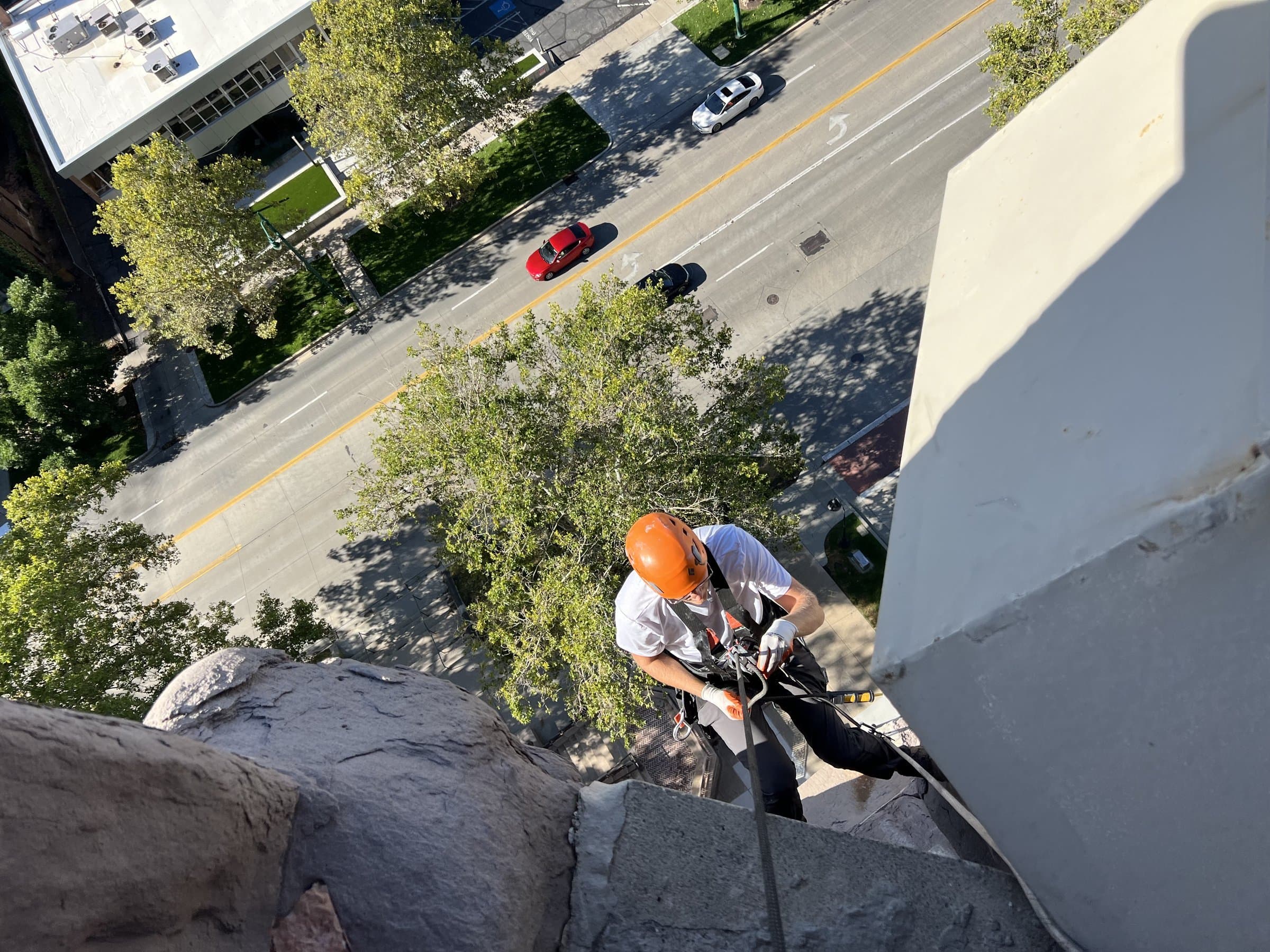
- High-rise / rope-access capacity for elevated buildings
- We finish failed prior jobs—remove old foam and devices
- Two-year written warranty on sealed whole-structure work
- Local eastern WA ownership, backed by a multi-state team
Typical Spokane jobs start with a phone consultation, then an attic inspection, followed by humane exclusion and optional guano cleanup. Commercial properties can use our commercial bat removal program.
Local bat facts for Spokane
HistoryLink records that Spokane incorporated in 1881 with about 1,000 residents, lost virtually its entire downtown (32 blocks) to the fire of August 4, 1889, and grew from almost 40,000 to more than 100,000 people between 1900 and 1910. Washington OFM puts the April 1, 2026 population at 235,900. WDFW’s current white-nose syndrome county lists do not include Spokane County, though the fungus or disease is confirmed in nearby Grant, Benton, Chelan and Kittitas counties. Under WAC 220-200-100 bats are protected wildlife except when found in or immediately adjacent to a dwelling or other occupied building.
Who to call in Spokane
- Bat in the house or any bat contact: Spokane Regional Health District, 509-324-1560 ext. 7. Covers the City of Spokane and all of Spokane County. Report even if no one thinks they were bitten.
- Domestic animals, stray pets, animal bites: SCRAPS (Spokane County Regional Animal Protection Service), 6815 E. Trent Ave., Spokane Valley; emergencies 509-477-2533, non-emergency 509-477-2532. Enforces the City of Spokane animal code. Domestic animals only, not wildlife.
- Police non-emergency: Crime Check, 509-456-2233; 911 for emergencies. Injured-wildlife emergencies: Washington State Patrol, 509-456-4101.
- Wildlife questions: WDFW Eastern Region 1 office, 2315 N. Discovery Place, Spokane Valley, 509-892-1001.
- Historic properties: City–County of Spokane Historic Preservation Office, 808 W. Spokane Falls Blvd., 509-625-6300.
- Bats living in the attic or walls: A private wildlife control operator. WDFW does not remove bats; it refers homeowners to nuisance wildlife control operators.
Sources
- Spokane Regional Health District – Animal bites and rabies
- SRHD – Bat Tests Positive for Rabies in Spokane County (July 2025)
- Spokane County – SCRAPS Animal Protection (City of Spokane code)
- Spokane County – Animal Enforcement (jurisdictions, wildlife referrals)
- HistoryLink – Spokane: Thumbnail History
- HistoryLink – Great Spokane Fire (1889)
- Spokane Historic Preservation Office – Historic districts
- Washington State DOH – Bats tested for rabies by county, 2021–2025 (PDF)
- Washington State DOH – Rabies activity in Washington
- WDFW – White-nose syndrome in Washington
- WDFW – Regional offices (Eastern Region 1)
- WDFW – Living with wildlife: Bats
- Washington OFM – April 1, 2026 population of cities, towns and counties
- WAC 220-200-100 – Wildlife classified as protected
Spokane bat removal FAQ
Spokane neighborhoods & nearby cities
- Spokane Valley bat removal
Spokane Valley / Spokane County
- Millwood bat removal
Spokane Valley / Spokane County
- Liberty Lake bat removal
Spokane Valley east / Idaho line
- Cheney bat removal
West Plains / Spokane County
- Airway Heights bat removal
West Plains / Spokane County
- Medical Lake bat removal
West Plains / Spokane County
- Deer Park bat removal
North Spokane County
- Moses Lake bat removal
Grant County / Columbia Basin
- Pullman bat removal
Palouse / Whitman County
- Wenatchee bat removal
Wenatchee Valley / Chelan County
- Kennewick bat removal
Tri-Cities / Benton County
- All service areas
Eastern Washington hub
- Why us
Proof points & team
- How we work
Process steps
- Warranty
Two-year coverage
- FAQ
Common questions
Bat problems in Spokane? Let's talk.
Humane exclusion for Spokane and the surrounding Spokane metro. Two-year written warranty on whole-structure work. Same-day often available across the 509.