Service
Bat attic and exterior inspections in eastern Washington
Scratching in the ceiling at dusk, dark droppings on the porch, or a bat that turned up in the living room all raise the same question: are bats living in this building, how many, and where are they getting in? WDFW says the exit hole a bat uses can be as small as ½ inch, and that old buildings, and shake or cedar-shingle roofs without underlayment, can have so many openings that complete exclusion takes careful work. Washington Wildlife Specialists inspects homes, rentals and commercial buildings across Spokane, the Tri-Cities, Yakima, Wenatchee and the rest of eastern Washington so you have a documented answer and a written plan before anyone sells you exclusion or cleanup.
When an inspection makes sense
Most calls start with one of a few things: noises in the attic or a wall around sunset, rice-sized black droppings stuck to siding or piled on a deck, an ammonia smell in an upstairs room, bats seen pouring out of the roofline on a summer evening, or a bat found inside the house. Inspections are also worth doing before buying a home, before a re-roof, siding or solar job, and after an earlier DIY attempt that didn’t work. If a bat was in the living space and may have touched someone, or was in a room where a person was sleeping, call your local health jurisdiction first; Washington DOH asks that only bats with possible contact be captured for testing, never with bare hands. The inspection comes after that step.
The outside walk: every place WDFW says bats get in
WDFW lists the common bat entry points as chimneys and where masonry meets the house, joints between window frames and siding, joints around large exterior beams, building corners, roof edges, ridge caps, soffits and fascia boards, where walls meet the eaves at the gable, where pipes or wires pass through attic walls, and the seams where porches or additions join the main house. We walk the whole envelope with binoculars and ladders, look for the dark rub marks WDFW says bat body oils leave on a well-used opening, and check for droppings stuck to the wall, since WDFW notes the exit hole is usually directly above them. Eastern Washington heat, wind and dust also open gaps over time, so we look closely at failed caulk, warped trim and sun-split vent screens.
Inside the attic: what we check and how we stay safe
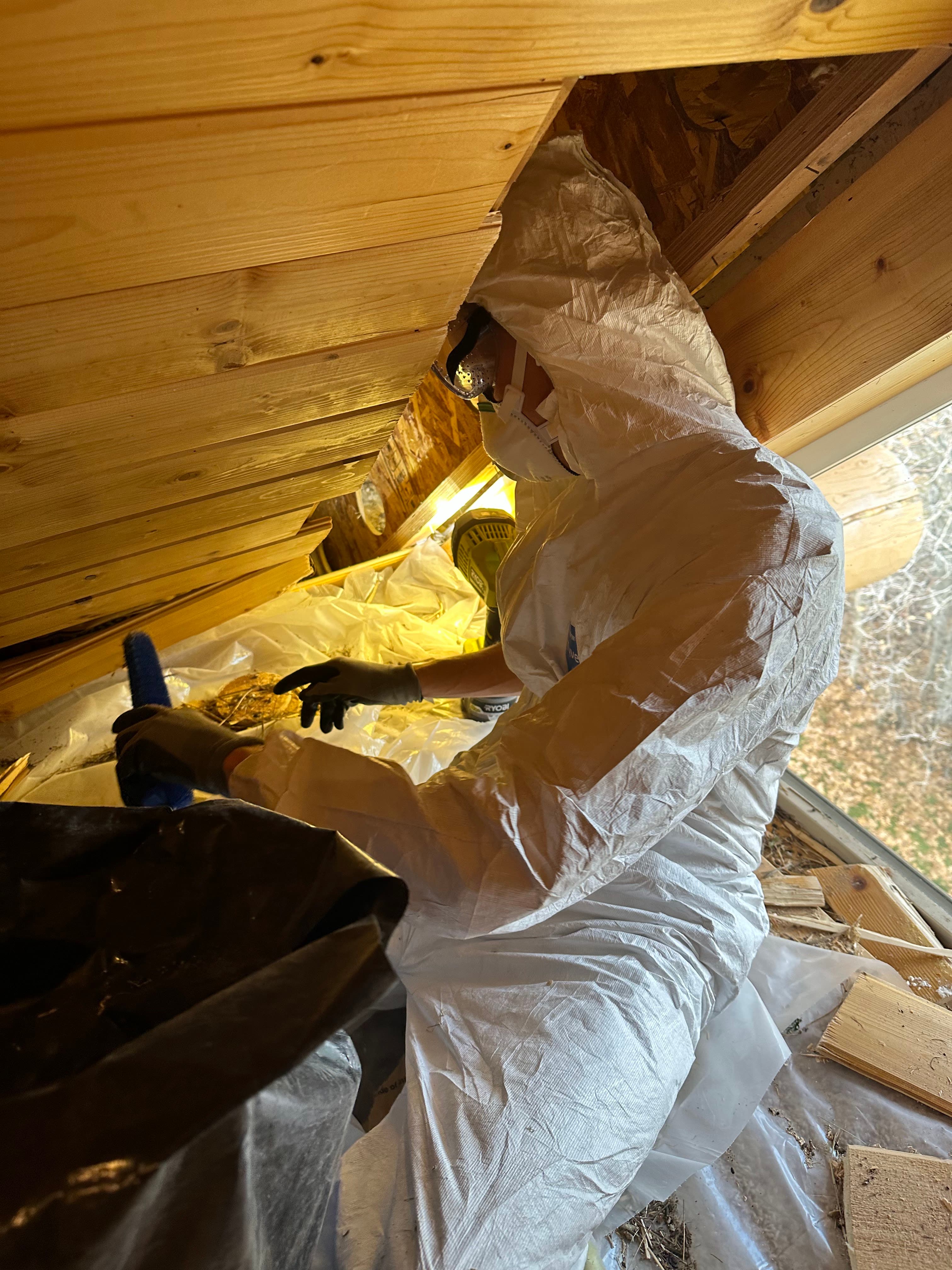
When the attic can be entered safely, we look for droppings on the insulation and framing, urine staining, roost areas along the ridge and at gable ends, dead bats, and daylight showing through cracks, which WDFW points to as a way to find openings missed from outside. We note where droppings piles sit relative to the hatch, wiring, bathroom fans and can lights. Because bat droppings can carry Histoplasma, NIOSH recommends respiratory protection, gloves and disposable coveralls for work that disturbs accumulated droppings, and we gear up accordingly and avoid stirring up dust during an inspection. Washington DOH reports Histoplasma has not been detected in Washington soil, but we treat any heavy deposit as something to clean professionally later, not to sweep during a visit.
Dusk exit watch: counting bats and finding the real exits
Many active entries only show themselves at sunset. WDFW’s method is to station watchers at the corners of the building after sunset on a warm, calm evening, note which side bats leave from, and then narrow in on the exact opening. When the season and the call make it useful, we do the same: watch the exits, estimate how many bats leave, and confirm which openings are in active use versus old staining. That count, and the location of every exit, is what decides how many one-way devices the job needs and whether the colony is a few bats behind a fascia board or a large maternity group in the attic.
Is it bats, birds, squirrels or mice?
Not every attic noise is bats. Bat droppings are dark, dry and crumble into shiny insect fragments, and they collect under roosts and stick to walls below exits. Mouse droppings are similar in size but harder and scattered along travel routes, and squirrels, birds and rodents chew, nest or carry in material; WDFW notes bats have small teeth for eating insects and do not gnaw holes, shred nesting material or chew wiring. If the evidence points somewhere other than bats, we tell you plainly and explain what we found, and light related-wildlife help is available when it shows up alongside a bat call.
Timing: what an inspection can lead to in each season
WDFW’s windows drive the plan. One-way exclusion fits mid-August to mid-October, after the young can fly, or early spring before births begin in May. Nursery colonies form around May, so summer inspections document the colony and schedule the work rather than evicting pups. WDFW advises leaving bats found hibernating in a building after October 15 alone until spring, while sealing any routes into living space now. That means a November-to-March inspection is still worthwhile: we map the building, seal openings into rooms, and have the exclusion ready to install as soon as the spring window opens. Bats are protected wildlife under WAC 220-200-100, though bats in or right next to an occupied building may be removed without a permit, which is why timing and one-way methods matter.
What you get after the visit
You receive photos of each entry point and sign we found, a marked-up map of the structure, our read on whether the colony is active and roughly how large, and recommended options: targeted repair of a few gaps, whole-structure exclusion and sealing (the path covered by our two-year written warranty), exclusion plus guano cleanup and insulation work, or monitoring if activity is inconclusive. The inspection is about building the real options for your house, not pressure. Homebuyers, landlords and facilities managers can use the same photo report for their records or to coordinate with a roofer.
Serving Spokane and eastern Washington—including Spokane, Kennewick, and Yakima. Start with an attic inspection if you are unsure what is in the structure.
Sources
- WDFW – Living with wildlife: Bats (entry points, exit watch, exclusion timing)
- WDFW – Hiring a Wildlife Control Operator
- WDFW – White-nose syndrome in bats
- Washington State DOH – Rabies (bats in living space, capture for testing)
- Washington State DOH – Histoplasmosis
- CDC/NIOSH – Personal protective equipment for Histoplasma
- WAC 220-200-100 – Wildlife classified as protected
Attic Inspection FAQ
Related services
- Bat Removal
Humane bat removal for eastern Washington homes: inspection and dusk exit watch, one-way exclusion timed to WD…
- Bat Exclusion
Professional bat exclusion for Spokane, Tri-Cities, Yakima and Wenatchee homes and buildings: full entry mappi…
- Guano Cleanup
Bat guano cleanup for eastern Washington attics, walls and commercial buildings: wet or HEPA removal under con…
- Commercial Bat Removal
Commercial bat removal for schools, churches, warehouses, packing and cold-storage buildings, multifamily and …
Bat education guides
- Bat guides hub
Signs, species, attic roosts, maternity timing, damage, and exclusion explained for eastern WA.
- Signs of bats
Guano, odor, dusk fly-outs, and grease marks on Spokane-area homes.
- How exclusion works
One-way devices, sealing sequence, and why DIY fails.
- Bat damage & health risks
Guano, odor, insulation and what WA DOH says about rabies and histoplasmosis.
Bat removal by city
- Spokane bat removal
Local Spokane housing patterns, seasonality, and CTAs.
- Spokane Valley bat removal
Local Spokane Valley housing patterns, seasonality, and CTAs.
- Liberty Lake bat removal
Local Liberty Lake housing patterns, seasonality, and CTAs.
- Cheney bat removal
Local Cheney housing patterns, seasonality, and CTAs.
- Airway Heights bat removal
Local Airway Heights housing patterns, seasonality, and CTAs.
- Kennewick bat removal
Local Kennewick housing patterns, seasonality, and CTAs.
- All service areas
Full eastern Washington coverage map and city list.
Talk through attic inspection for your building
Serving Spokane, Spokane Valley, Liberty Lake, Cheney, Airway Heights, Moses Lake, the Tri-Cities (Kennewick, Pasco, Richland, West Richland), Yakima, Selah, Moxee, Union Gap, Wapato, Zillah, Toppenish, Wenatchee, East Wenatchee, Pullman, Clarkston, Walla Walla, College Place, Ellensburg, Sunnyside, Grandview, Prosser, Benton City, Medical Lake, Deer Park, Ephrata, and Millwood. Same-day available across the 509. Humane, WDFW-aware exclusion with a two-year written warranty.