Service
Professional bat exclusion for eastern Washington homes and buildings
Exclusion is how bats are legally and permanently removed from a building in Washington: every gap the colony could use is found, the active exits get one-way devices so the bats leave on their own, and the building is sealed once they are gone. WDFW calls humane exclusion the best way to get rid of bats and the safest for both the bats and the people involved, and it does not recommend trapping and relocating them. Washington Wildlife Specialists has done exclusion work since 2011 on homes, rentals, shops, churches and commercial buildings from Spokane and the Palouse to the Tri-Cities, Yakima Valley and Wenatchee. This page covers what our exclusion service includes, how we time it to WDFW’s seasonal rules, how we seal different building types, and what the warranty covers. For a step-by-step explanation of the method itself, see our guide on how bat exclusion works.
What our exclusion service includes
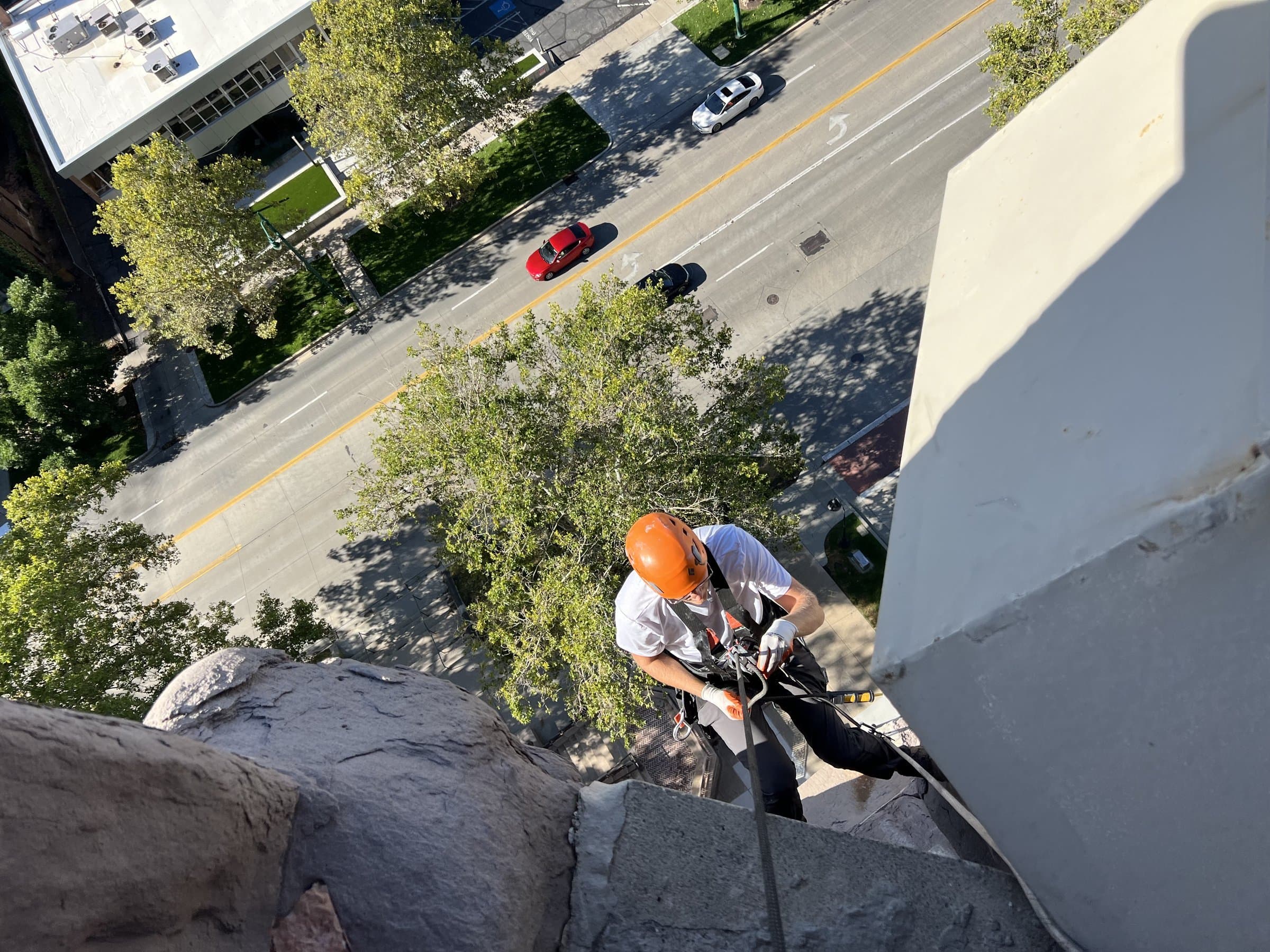
Every job starts with an inspection of the whole building, not just the hole a homeowner noticed. We go over the roofline, gables, soffits, fascia, ridge, chimney, siding joints, window trim, pipe and wire penetrations, and the seams where additions, porches or garages meet the main structure, and we look inside the attic when it can be entered safely. In season we also watch the building at dusk to count bats and confirm which gaps they actually use. You get a written entry-point map and a plan that separates active exits from secondary gaps. We then seal the secondary gaps, fit one-way devices on the active exits, monitor until activity stops, remove the devices, permanently seal those last openings and photograph every sealed point.
Matching the one-way device to the opening
There is no single exclusion product that works everywhere. WDFW describes two main kinds of one-way device: a door made of plastic sheeting, screen or lightweight polypropylene netting hung over an exit so it extends below the opening and flops shut behind each bat, and a smooth-sided tube at least 2 inches across and about 10 inches long for spots where a door will not hang, such as horizontal surfaces. Long crevices such as flashing pulled away from a wall need several devices spaced along the run with the gaps between them closed, and chimneys can be fitted with a hardware-cloth cage and tube. We choose and size each device for the opening, the roof pitch and the siding, and fasten it so wind does not open a gap around it.
When exclusion can happen: WDFW’s calendar for Washington
Timing decides whether exclusion is humane and whether it works. WDFW says pups are born in nursery colonies starting around May and that excluding or sealing while young cannot fly can strand them inside or cause mothers to drop or abandon them, so the main window is mid-August to mid-October, after the young can fly and before cold weather. Early spring, before births, is the second window. WDFW also says Washington bats move into hibernation sites in late September or October and stay until April or early May, and that bats found hibernating in a building after October 15 should be left alone until early spring. Sealing a building with no bats inside (building them out) fits mid-October to mid-March, but only after an inspection shows none are hibernating there. That is why a call in November or December usually means inspection and interior sealing now and full exclusion in spring.
Monitoring: how we know the bats are out
WDFW recommends leaving one-way devices up for five to seven days, longer in cool or rainy weather when bats may not fly every night, and warns that forcing a large colony through a single exit can cause a bat log jam that sends bats looking for another way out, sometimes into the living space. We leave devices up through enough good flying nights, check them after windy days in the Columbia Basin and the Palouse, watch at dusk when needed, and look for fresh droppings below the exits. Only when activity has stopped do we pull the devices and close the final openings. If a bat does turn up inside during the process, Washington DOH says not to touch it bare-handed and to contact the local health department if anyone may have had contact.
Sealing by building type
Eastern Washington buildings fail in predictable places. Older brick and frame homes in Spokane, Walla Walla, Yakima and Wenatchee leak at chimney flashing, mortar joints, gable vents and fascia corners. Mid-century ranches in the Tri-Cities and Moses Lake leak at soffit returns, garage tie-ins and roof-to-wall joints. Newer subdivisions leak at ridge vents, siding J-channel and corner trim. Metal shops, ag buildings and warehouses leak along ridge caps, eaves, panel seams and door tracks. WDFW notes that bats can use an opening as small as half an inch. We seal with exclusion-grade materials: clear, paintable exterior sealant for small gaps, custom-cut inserts for larger gaps and metal-roof ribs, hardware cloth and screen for vents, flashing and caps for chimneys, mortar repair for brick, and proper covers for weep holes. WDFW says caulk has advantages over foam because it comes in more colors, is easier to apply and can be painted; we do not use spray foam at all because heat, cold, wind and sun in the 509 break it down.
Targeted repair or whole-structure exclusion
When it makes sense we price two options. A targeted repair seals the active exits and the gaps right around them. A whole-structure exclusion seals every potential entry on the building envelope. Only the whole-structure option carries our two-year written warranty, with lifetime warranties available on request, because sealing only the holes the bats are using now often moves the colony a few feet down the same roofline. WDFW also cautions that some older buildings, especially those with shake or cedar-shingle roofs and no underlayment, may be impossible to exclude completely; if we find that on your building, we tell you before you pay for work that cannot be guaranteed.
What exclusion is not: poisons, repellents and relocation
All bats are protected wildlife in Washington under WAC 220-200-100. Bats in or immediately next to an occupied building may be removed without a permit, which is why humane exclusion is the standard rather than killing or trapping. WDFW says naphthalene flakes and mothballs should not be used because they can be toxic to people and pets, that repellents do not replace excluding a roost, and that trapping and moving bats does not work well; Yuma myotis released 240 miles away have found their way home. We never use poisons, never seal a colony inside and never relocate bats. After exclusion, bats move to other roosts nearby, and WDFW suggests a properly built bat house mounted in full sun near the old exit as an alternative roost for homeowners who want one.
After exclusion: droppings and health
Once the building is sealed, any droppings left in the attic or walls can be dealt with. Small amounts can be cleaned during the job. Heavy deposits are a separate guano cleanup: Washington DOH says large amounts of bird or bat droppings should be cleaned up by companies that specialize in it, and NIOSH recommends respiratory protection, gloves and disposable coveralls for work that disturbs accumulated droppings because of the fungus that causes histoplasmosis. We schedule cleanup after exclusion so new droppings do not land on clean insulation. White-nose syndrome is another reason we follow WDFW’s rules. WDFW confirmed the disease in Washington in 2016.
Serving Spokane and eastern Washington—including Spokane, Kennewick, and Yakima. Start with an attic inspection if you are unsure what is in the structure.
Sources
- WDFW – Living with wildlife: Bats (exclusion methods, one-way devices, timing)
- WDFW – White-nose syndrome in Washington
- WDFW – Hiring a Wildlife Control Operator
- WAC 220-200-100 – Wildlife classified as protected
- Washington State DOH – Rabies
- Washington State DOH – Histoplasmosis
- CDC/NIOSH – Histoplasmosis: personal protective equipment
Exclusion FAQ
Related services
- Bat Removal
Humane bat removal for eastern Washington homes: inspection and dusk exit watch, one-way exclusion timed to WD…
- Attic Inspection
Bat inspections for eastern Washington homes and buildings: attic and roofline check, dusk exit watch, entry-p…
- Guano Cleanup
Bat guano cleanup for eastern Washington attics, walls and commercial buildings: wet or HEPA removal under con…
- Commercial Bat Removal
Commercial bat removal for schools, churches, warehouses, packing and cold-storage buildings, multifamily and …
Bat education guides
- Bat guides hub
Signs, species, attic roosts, maternity timing, damage, and exclusion explained for eastern WA.
- Signs of bats
Guano, odor, dusk fly-outs, and grease marks on Spokane-area homes.
- How exclusion works
One-way devices, sealing sequence, and why DIY fails.
- Bat damage & health risks
Guano, odor, insulation and what WA DOH says about rabies and histoplasmosis.
Bat removal by city
- Spokane bat removal
Local Spokane housing patterns, seasonality, and CTAs.
- Spokane Valley bat removal
Local Spokane Valley housing patterns, seasonality, and CTAs.
- Liberty Lake bat removal
Local Liberty Lake housing patterns, seasonality, and CTAs.
- Cheney bat removal
Local Cheney housing patterns, seasonality, and CTAs.
- Airway Heights bat removal
Local Airway Heights housing patterns, seasonality, and CTAs.
- Kennewick bat removal
Local Kennewick housing patterns, seasonality, and CTAs.
- All service areas
Full eastern Washington coverage map and city list.
Talk through exclusion for your building
Serving Spokane, Spokane Valley, Liberty Lake, Cheney, Airway Heights, Moses Lake, the Tri-Cities (Kennewick, Pasco, Richland, West Richland), Yakima, Selah, Moxee, Union Gap, Wapato, Zillah, Toppenish, Wenatchee, East Wenatchee, Pullman, Clarkston, Walla Walla, College Place, Ellensburg, Sunnyside, Grandview, Prosser, Benton City, Medical Lake, Deer Park, Ephrata, and Millwood. Same-day available across the 509. Humane, WDFW-aware exclusion with a two-year written warranty.