Spokane Valley / Spokane County · 509
Bat removal in Spokane Valley, Washington
Spokane Valley is the broad, gravelly valley of the Spokane River between Spokane and the Idaho line, and since March 31, 2003 it has been its own city. HistoryLink calls it the largest incorporation in Washington history, about 80,700 people on day one, and Washington OFM puts the April 1, 2026 population at 110,800 (2020 census: 102,976). That growth, plus the river, the Centennial Trail corridor and the pine-covered hills on both sides, means a lot of buildings close to good bat habitat. Washington DOH’s 2026 rabies table lists two rabid bats collected in Spokane County in July 2026, and Spokane Regional Health District asks residents to report any bat found in the home. Washington Wildlife Specialists handles Spokane Valley attic, wall, garage, shop and commercial exclusions with inspection-first, one-way methods timed to WDFW guidance, never poisons, and a two-year written warranty on whole-structure work.
Local housing & attic patterns in Spokane Valley
HistoryLink traces the Valley’s buildings in layers. Irrigation arrived in 1895, and after the Spokane Aquifer was tapped in 1900, apple orchards spread until there were more than 1.6 million trees by 1922, which is how Appleway got its name. Farmhouses and early-1900s homes from that era still stand around Opportunity, Veradale, Greenacres and Dishman. The orchards were pulled out by the 1950s, and the 1942 Trentwood aluminum mill and the Velox Naval Supply Depot (sold as an industrial park in 1958) brought jobs and then subdivisions: HistoryLink counts the Valley growing from 46,458 to 82,153 people between 1960 and 1980. So most Valley homes are postwar and 1960s–70s ranches, split-levels and daylight basements, followed by 1990s–2020s subdivisions, townhomes and HOA communities, with metal shops, pole barns, warehouses and big commercial roofs from Trentwood to the Sprague and Appleway corridors. Older houses leak at gable vents, fascia corners, chimney flashing and where additions meet the original roof. Ranches and split-levels leak at soffit returns, attic-vent screens, roof-to-wall joints and garage tie-ins. Newer homes and townhomes leak at ridge-vent ends, J-channel and corner trim, and stone or stucco transitions. WDFW notes bats can squeeze through an opening as small as half an inch, so we inspect the whole house, the attached and detached garages, and any shop on the lot.
Bat seasonality around Spokane Valley
WDFW says Washington bats enter hibernation sites in late September or October and stay until April or early May, and pups are raised in nursery colonies beginning around May. In the Valley, colonies build through late spring and are biggest and loudest in July and August, when hot attics push bats into wall voids and cooler corners and young bats learning to fly sometimes end up inside the house. Little brown and Yuma bats like to hunt over water, so homes near the Spokane River, Shelley Lake and the Centennial Trail see heavy dusk traffic. One-way exclusion fits mid-August to mid-October, after the young can fly, or early spring before births. WDFW advises leaving bats found hibernating in a building after October 15 alone until spring, so a November or winter call in Spokane Valley usually means an inspection, sealing any routes into living space now, and scheduling the full exclusion for the next window.
Neighborhoods & landmarks we know
We work across all of Spokane Valley’s old communities: Dishman and the Dishman Hills edge, Opportunity around Sprague and Pines, Veradale, Greenacres, University and Edgecliff, Trentwood and East Trent, Yardley and the Velox industrial area, Orchard Park and the neighborhoods along the river and Plante’s Ferry Park, plus the newer subdivisions and HOA communities on the north and south sides of the valley floor. Commercial and industrial work runs along Sprague Avenue, Appleway, Broadway, Trent Avenue and the I-90 corridor. Liberty Lake, Millwood and east Spokane addresses are on the same route; call with the address to confirm scheduling.
Why hire a local eastern Washington crew
A 1910s orchard-era farmhouse in Greenacres, a 1970s split-level in University, a 2010s townhome in a Valley HOA and a metal warehouse in Trentwood each fail in different places, and we scope and price each one on its own. Inland freeze-thaw cycles break down cheap foam and caulk, so we seal with exclusion-grade materials matched to the trim, siding or panel profile, never expanding spray foam. Shared-roof townhomes need the whole building mapped so bats aren’t pushed into a neighbor’s unit, and HOA boards and property managers get photo logs of every sealed entry. We time every exclusion to WDFW guidance and back whole-structure work with a two-year written warranty.
- Bat specialists since 2011 — bats are our flagship service
- Documented inspection: openings numbered, photographed, primary vs. secondary
- Targeted repair or whole-structure seal (warranty on whole-structure)
- Humane one-way exclusion · WDFW-aware timing (May–August maternity)
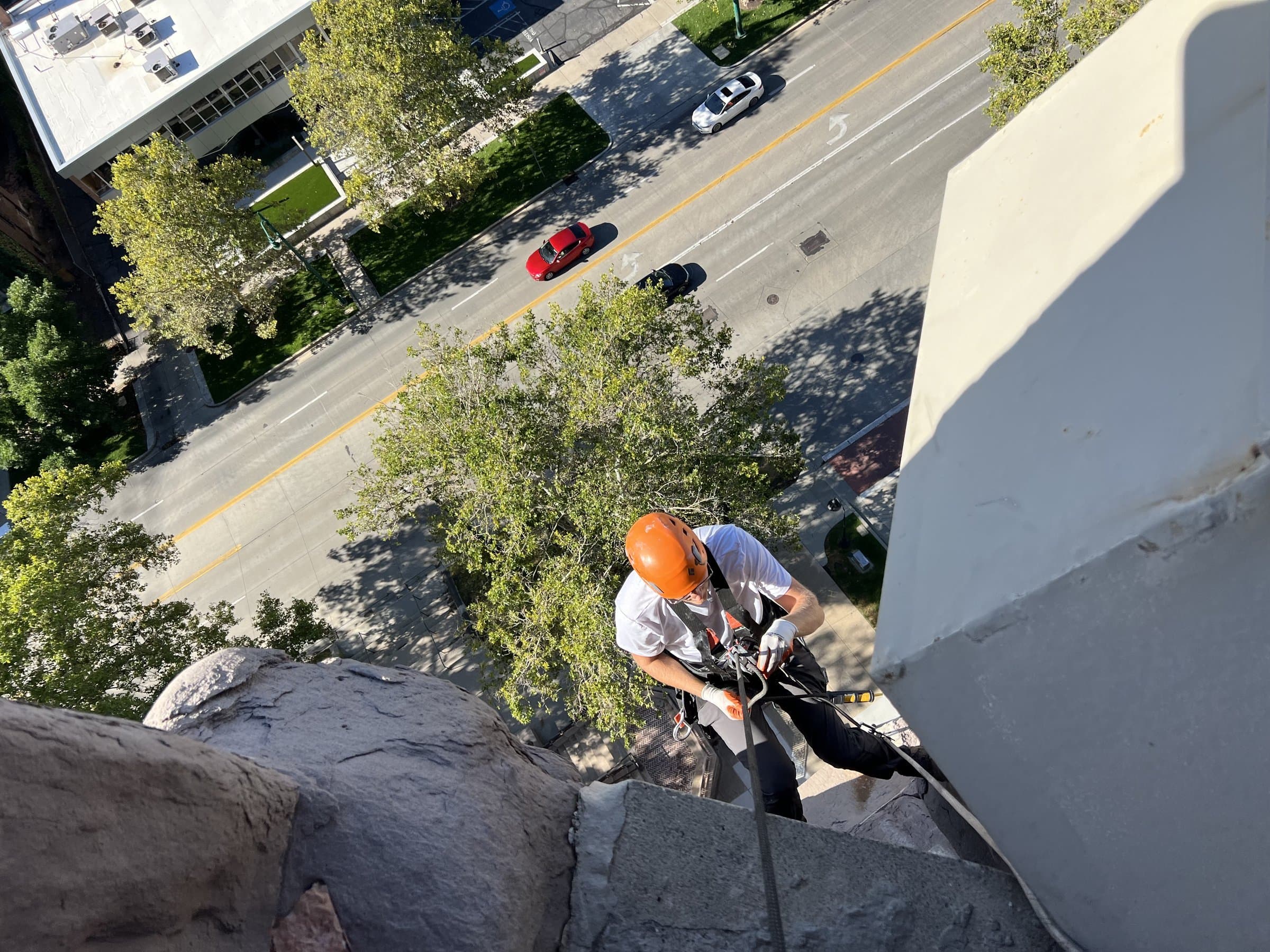
- High-rise / rope-access capacity for elevated buildings
- We finish failed prior jobs—remove old foam and devices
- Two-year written warranty on sealed whole-structure work
- Local eastern WA ownership, backed by a multi-state team
Typical Spokane Valley jobs start with a phone consultation, then an attic inspection, followed by humane exclusion and optional guano cleanup. Commercial properties can use our commercial bat removal program.
Local bat facts for Spokane Valley
HistoryLink records that Spokane Valley voters approved incorporation 51.3% to 48.7% on May 21, 2002, and the city became official on March 31, 2003 with about 80,700 residents. Washington OFM puts the April 1, 2026 population at 110,800 (2020 census: 102,976). WDFW’s current white-nose syndrome county lists do not include Spokane County, though the disease is confirmed in Chelan, Kittitas and Benton counties. Under WAC 220-200-100 bats are protected wildlife except when found in or immediately adjacent to a dwelling or other occupied building.
Who to call in Spokane Valley
- Bat in the house or any bat contact: Spokane Regional Health District, 509-324-1560 ext. 7. Report even if no one thinks they were bitten.
- Domestic animal emergencies and bites: SCRAPS (Spokane County Regional Animal Protection Service), 6815 E. Trent Ave., Spokane Valley; emergency line 509-477-2533, non-emergency 509-477-2532. SCRAPS handles domestic animals only, not wildlife.
- Police non-emergency: Spokane Valley Police Department (Spokane County Sheriff’s Office under contract), precinct at 12710 E. Sprague Ave.; Crime Check 509-456-2233; 911 for emergencies. Injured-wildlife emergencies: Washington State Patrol, 509-456-4101.
- Wildlife questions: WDFW Eastern Region 1 office, 2315 N. Discovery Place, Spokane Valley, 509-892-1001 (Monday–Friday 9 a.m.–4 p.m.).
- City services: Spokane Valley City Hall, 10210 E. Sprague Ave., 509-720-5000.
- Bats living in the attic or walls: A private wildlife control operator. WDFW does not remove bats; it refers homeowners to nuisance wildlife control operators.
Sources
- Spokane Regional Health District – Animal Bites (bats and rabies reporting)
- SRHD – Bats, Bites, and Rabies: What You Need to Know
- City of Spokane Valley – SCRAPS Animal Protection
- Spokane County – Animal Enforcement (SCRAPS jurisdiction, domestic animals only)
- City of Spokane Valley – Police Department
- City of Spokane Valley – About Our City
- HistoryLink – Spokane Valley: Thumbnail History
- HistoryLink – Spokane Valley incorporation becomes official (March 31, 2003)
- Washington State DOH – Rabies activity in Washington
- WDFW – White-nose syndrome in Washington
- WDFW – Regional offices (Eastern Region 1)
- WDFW – Hiring a Wildlife Control Operator
- WDFW – Living with wildlife: Bats
- Washington OFM – April 1, 2026 population of cities, towns and counties
- WAC 220-200-100 – Wildlife classified as protected
Spokane Valley bat removal FAQ
Spokane Valley & nearby cities
- Spokane bat removal
Spokane metro
- Millwood bat removal
Spokane Valley / Spokane County
- Liberty Lake bat removal
Spokane Valley east / Idaho line
- Deer Park bat removal
North Spokane County
- Airway Heights bat removal
West Plains / Spokane County
- Cheney bat removal
West Plains / Spokane County
- Pullman bat removal
Palouse / Whitman County
- Moses Lake bat removal
Grant County / Columbia Basin
- Wenatchee bat removal
Wenatchee Valley / Chelan County
- Kennewick bat removal
Tri-Cities / Benton County
- Walla Walla bat removal
Walla Walla Valley / Walla Walla County
- All service areas
Eastern Washington hub
- Why us
Proof points & team
- How we work
Process steps
- Warranty
Two-year coverage
- FAQ
Common questions
Bat problems in Spokane Valley? Let's talk.
Humane exclusion for Spokane Valley and the surrounding Spokane Valley / Spokane County. Two-year written warranty on whole-structure work. Same-day often available across the 509.