Spokane Valley / Spokane County · 509
Bat removal in Millwood, Washington
Millwood is a small city of tree-lined blocks on the north bank of the Spokane River, surrounded on all sides by Spokane Valley, and Washington OFM puts its April 1, 2026 population at 1,925 (2020 census: 1,881). The river, big old shade trees and a century of wood-trimmed houses make it good bat country: little brown and Yuma bats hunt over the river at dusk, and old attics and wall voids give them warm summer roosts. Washington DOH’s 2026 rabies table lists two rabid bats collected in Spokane County in July 2026, and Spokane Regional Health District asks residents to report any bat found inside a home. Washington Wildlife Specialists handles Millwood attic, wall, chimney, garage and small commercial exclusions with an inspection first, one-way devices timed to WDFW guidance, permanent sealing, no poisons, and a two-year written warranty on whole-structure work.
Local housing & attic patterns in Millwood
HistoryLink’s essay on Millwood’s incorporation explains its houses. The Woodard family farmed here from 1882, and in 1903 Seth Woodard gave the electric interurban railway a right-of-way in exchange for a stop called Woodard Station. When the Inland Empire Paper Company began building a mill on the river in 1910, the company and the family compromised on a new town name, Millwood, and the mill started production in September 1911. The company shaped the town: it bought nearly 70 lots around the mill, set up a revolving home-loan fund and offered employees an architectural pattern book of house plans, and homes were built under the program from 1923 through 1928. Millwood incorporated on October 26, 1927, the first incorporated town in the Spokane Valley, and in 2001 an eight-block area bounded by Argonne Road, Sargent Road, Liberty Avenue and Euclid Avenue, including the two-block downtown, was listed as a National Register historic district. So Millwood has 1910s–1920s bungalows, cottages and period-revival houses from the company era, the 1923 Rosebush House and other landmark homes, mid-century and postwar houses on the blocks outside the district, small apartment buildings, brick and frame storefronts along Argonne Road and Euclid Avenue, and older detached garages and sheds on deep lots. Century-old houses leak at gable vents, eave returns, fascia corners, chimney flashing and crowns, attic louvers, and where porches, dormers and additions meet the original roof. Old detached garages and carriage houses often have open rafter tails and gaps under the roof sheathing. WDFW notes bats can use an opening as small as half an inch, so we check the house, the garage and any outbuilding on the lot.
Bat seasonality around Millwood
WDFW says Washington bats enter hibernation sites in late September or October and stay until April or early May, and that pups are raised in nursery colonies starting around May. Millwood’s riverfront location matters: WDFW notes little brown and Yuma bats prefer to hunt over water, and homes within a few blocks of the Spokane River see heavy dusk traffic from June through September. Colonies are largest and most noticeable in July and August, when hot attics push bats into wall voids and young bats learning to fly sometimes end up inside. One-way exclusion fits mid-August to mid-October, after the young can fly, or early spring before births. WDFW advises leaving bats found hibernating in a building after October 15 alone until spring, so a late-fall or winter call in Millwood usually means an inspection, sealing any routes into living space now, and scheduling the full exclusion for the next window.
Neighborhoods & landmarks we know
We work throughout Millwood: the National Register historic district between Argonne and Sargent roads and Liberty and Euclid avenues, the downtown blocks on Argonne and Euclid, the streets around City Hall at 9103 E. Frederick Ave. and the Inland Empire Paper mill grounds, riverfront homes along the Spokane River, and the residential blocks named for the Woodard children, like Marguerite and Ella. Surrounding Spokane Valley neighborhoods such as Orchard Park, Pasadena Park, Trentwood and Yardley, plus east Spokane, are on the same route; call with the address to confirm scheduling.
Why hire a local eastern Washington crew
In a town where so many homes are about a century old, how you seal matters as much as what you seal. We match materials to the original wood trim, siding, shingle or brick and use mesh, flashing and sealants instead of expanding spray foam, which fails in Spokane-area freeze-thaw winters and is hard to remove from old trim. Older two-story homes often need ladder or lift access at the gables and chimney, and detached garages and carriage houses get checked too, since colonies often use them. Small apartment buildings and Argonne Road storefronts get a full-roofline map so bats aren’t pushed into a neighbor’s unit. We time every exclusion to WDFW guidance and back whole-structure work with a two-year written warranty.
- Bat specialists since 2011 — bats are our flagship service
- Documented inspection: openings numbered, photographed, primary vs. secondary
- Targeted repair or whole-structure seal (warranty on whole-structure)
- Humane one-way exclusion · WDFW-aware timing (May–August maternity)
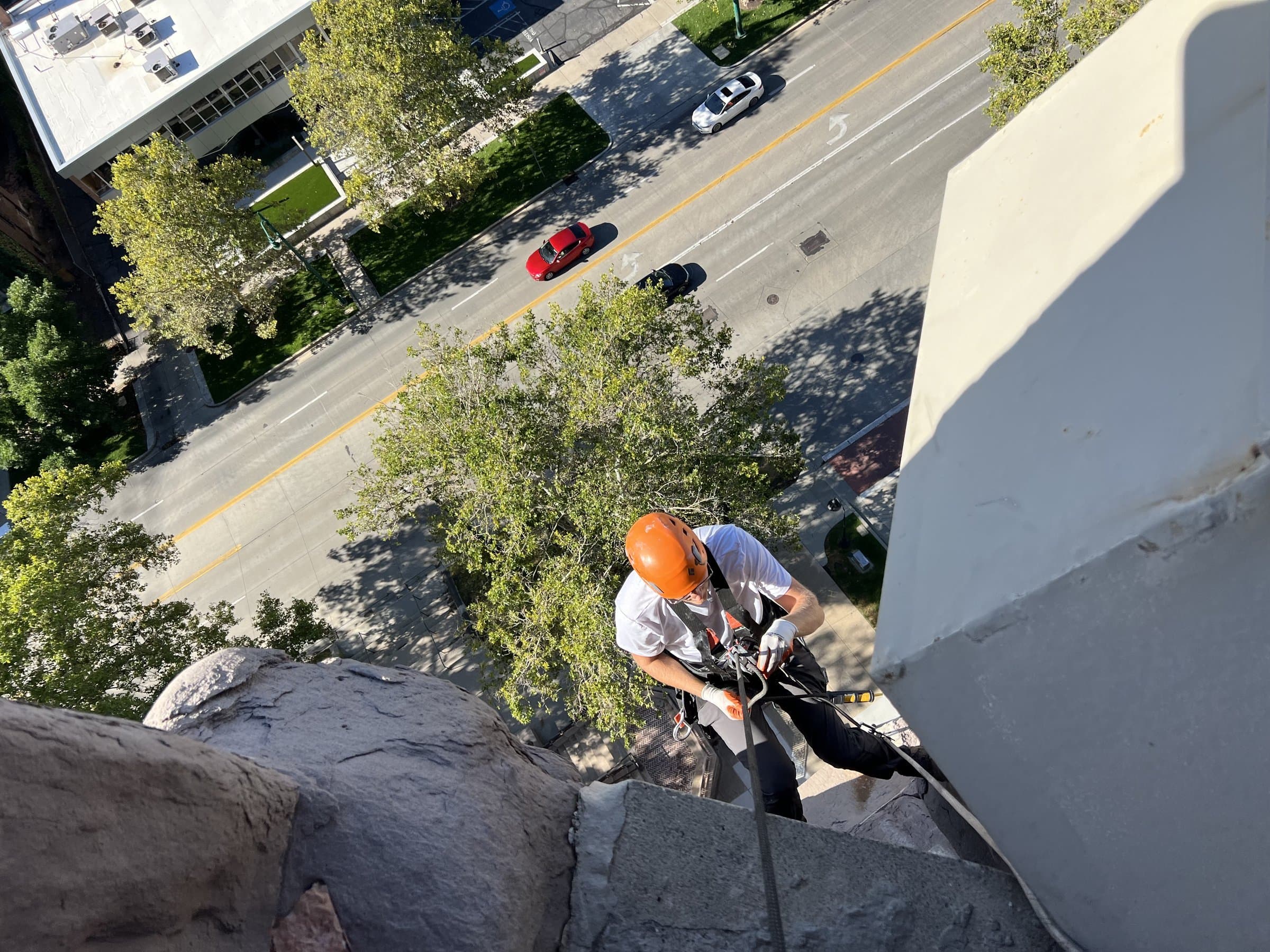
- High-rise / rope-access capacity for elevated buildings
- We finish failed prior jobs—remove old foam and devices
- Two-year written warranty on sealed whole-structure work
- Local eastern WA ownership, backed by a multi-state team
Typical Millwood jobs start with a phone consultation, then an attic inspection, followed by humane exclusion and optional guano cleanup. Commercial properties can use our commercial bat removal program.
Local bat facts for Millwood
HistoryLink records that Millwood residents voted 75 to 5 to incorporate and the town became official on October 26, 1927, the first incorporated town in the Spokane Valley, with paper-mill president W. A. Brazeau as its first mayor; an eight-block area was listed as a National Register historic district in 2001. Washington OFM puts Millwood at 1,925 people on April 1, 2026. WDFW’s current white-nose syndrome county lists do not include Spokane County. Under WAC 220-200-100 bats are protected wildlife except when found in or immediately adjacent to a dwelling or other occupied building.
Who to call in Millwood
- Bat in the house or any bat contact: Spokane Regional Health District, 509-324-1560 ext. 7. Covers Millwood and all of Spokane County. Report even if no one thinks they were bitten.
- Domestic animals, stray pets, animal bites: SCRAPS (Spokane County Regional Animal Protection Service), 6815 E. Trent Ave., Spokane Valley; non-emergency 509-477-2532, emergencies 509-477-2533. Serves Millwood. Domestic animals only, not wildlife.
- Law enforcement: Spokane County Sheriff’s Office, under an interlocal agreement with the City of Millwood. Non-emergency Crime Check 509-456-2233; 911 for emergencies. Injured-wildlife emergencies: Washington State Patrol, 509-456-4101.
- Wildlife questions: WDFW Eastern Region 1 office, 2315 N. Discovery Place, Spokane Valley, 509-892-1001.
- City Hall: City of Millwood, 9103 E. Frederick Ave. (corner of Argonne Rd.), 509-924-0960, Monday–Friday 8 a.m.–4 p.m.
- Bats living in the attic or walls: A private wildlife control operator. WDFW does not remove bats; it refers homeowners to nuisance wildlife control operators.
Sources
- SRHD – Animal bites and rabies (Millwood reports to SCRAPS/SRHD)
- Spokane County – SCRAPS Animal Protection (cities served)
- Spokane County – Animal Enforcement (domestic animals only, wildlife referrals)
- City of Millwood – Code compliance complaint referral guide
- City of Millwood – About Us
- Spokane County Sheriff – Contract law enforcement cities
- HistoryLink – Millwood incorporates on October 26, 1927
- Spokane Historical – The Arrival of the Paper Mill at Woodard
- Washington State DOH – Bats tested for rabies by county, 2021–2025 (PDF)
- Washington State DOH – Rabies activity in Washington
- WDFW – White-nose syndrome in Washington
- WDFW – Regional offices (Eastern Region 1)
- WDFW – Living with wildlife: Bats
- Washington OFM – April 1, 2026 population of cities, towns and counties
- WAC 220-200-100 – Wildlife classified as protected
Millwood bat removal FAQ
Millwood & nearby Spokane Valley cities
- Spokane Valley bat removal
Spokane Valley / Spokane County
- Spokane bat removal
Spokane metro
- Liberty Lake bat removal
Spokane Valley east / Idaho line
- Deer Park bat removal
North Spokane County
- Airway Heights bat removal
West Plains / Spokane County
- Cheney bat removal
West Plains / Spokane County
- Medical Lake bat removal
West Plains / Spokane County
- All service areas
Eastern Washington hub
- Why us
Proof points & team
- How we work
Process steps
- Warranty
Two-year coverage
- FAQ
Common questions
Bat problems in Millwood? Let's talk.
Humane exclusion for Millwood and the surrounding Spokane Valley / Spokane County. Two-year written warranty on whole-structure work. Same-day often available across the 509.