What bats don’t damage (and why that matters)
Homeowners often assume a bat colony is chewing its way through the attic. WDFW says it isn’t: unlike rodents, bats don’t gnaw holes, build nests from your insulation or chew wiring, and they don’t cause structural damage. Bats use gaps that already exist, often as small as half an inch, at ridge vents, gable vents, fascia corners, chimney flashing, soffit returns and siding laps. That changes how a repair is scoped. If you see chewed wiring, torn screens or shredded insulation, there is usually a second animal involved (mice, rats, squirrels or birds), and the inspection needs to account for it. If the only evidence is droppings, staining and odor, the job is about sealing existing gaps, removing what the bats left, and keeping them out.
Guano in the attic: insulation, framing and ceilings
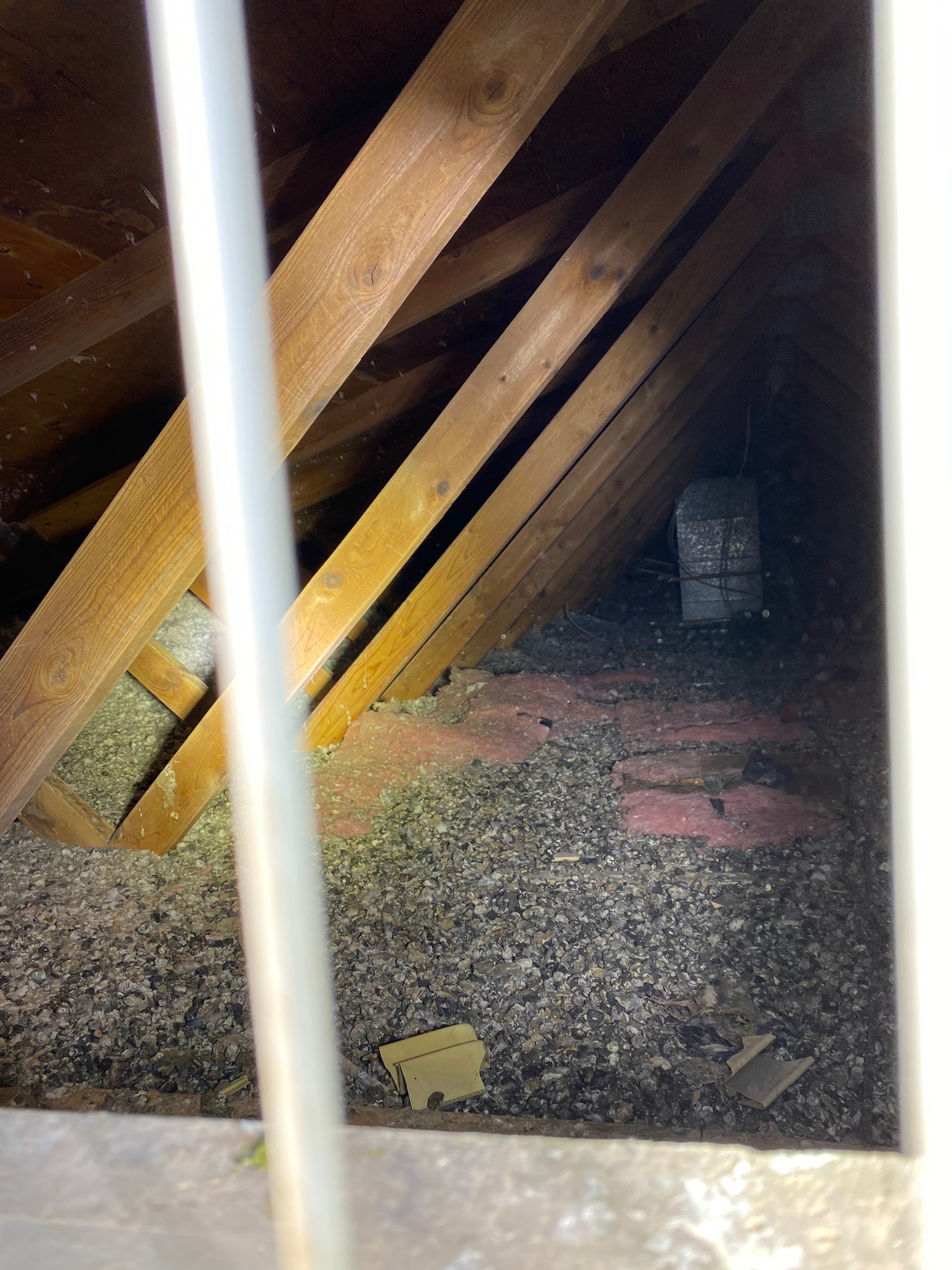
Bat droppings collect directly under where bats hang, so an attic colony builds piles on the insulation beneath the ridge, along the top plate under a gable vent, or at the bottom of a wall cavity. WDFW notes that bats often defecate on the way in and out, leaving rice-sized black droppings stuck to the siding right below an exit. Over several summers, loose-fill or batt insulation under a roost becomes packed with guano and soaked with urine, which compresses it and reduces how well it insulates. Urine can stain the top of drywall ceilings, roof sheathing and framing, and in older eastern Washington homes with plaster ceilings or tongue-and-groove sheathing it can wick into the wood. Light, scattered droppings can often be cleaned in place; heavy, long-term accumulations usually mean removing and replacing the affected insulation.
Odor, staining and rub marks
The first sign many homeowners notice is the smell: a sharp ammonia odor in an upstairs room, closet or attic hatch on hot afternoons. WDFW warns that sealing bats in, or trapping flightless young inside, can create a serious odor problem, which is one more reason exclusion has to be timed correctly. Outside, a well-used opening picks up a dark, greasy stain from bat body oils, and droppings streak the siding, trim, brick or stucco below it. Those marks are useful during the inspection because they point to the exits, but they also mean siding and trim cleaning should be part of the finish work once the bats are gone.
Rabies: the health issue that matters most
The Washington State Department of Health says bats are the only known reservoir of rabies in the state, and its rabies activity table for 2026 lists rabid bats collected from counties on both sides of the Cascades, including Spokane, Yakima, Chelan and Asotin. WDFW points out that people cannot get rabies from touching bat droppings, blood, urine or fur; the risk comes from a bite, a scratch, or saliva contacting the eyes, nose, mouth or broken skin. DOH estimates that fewer than 1% of wild bats carry rabies, but bat bites can be too small to notice. So the rule is simple: never handle a bat bare-handed, and if a bat may have touched a person or pet, or was found in a room with someone sleeping, a young child, or anyone who can’t say for sure, don’t release it. Contain it safely and call your local health jurisdiction, such as Spokane Regional Health District, Benton-Franklin Health District, Yakima Health District or Chelan-Douglas Health District, so it can be tested if needed.
Histoplasmosis: what the evidence says for Washington
Histoplasmosis is a lung infection caused by breathing spores of the Histoplasma fungus, which grows in soil or material containing bird or bat droppings. CDC notes that, unlike birds, bats themselves can be infected and may shed the fungus in their droppings, and advises treating any material suspected of contamination as if it contains Histoplasma. The Washington picture is more reassuring: DOH says Histoplasma has not been detected in soil in Washington (though soils aren’t routinely tested), and its April 2024 epiTRENDS bulletin reported no confirmed locally acquired cases in the state; most reported cases involved travel to or residence in endemic regions. DOH is monitoring because the fungus may be spreading west. The practical takeaway is the same either way: don’t dry-sweep or shop-vac a guano pile, and avoid the work entirely if you have a weakened immune system.
Safe cleanup: what DOH and WDFW recommend
DOH’s histoplasmosis guidance says large amounts of bird or bat droppings should be cleaned up by companies that specialize in it, and that if you must remove droppings yourself you should first mist the area with water to keep dust down and wear disposable gloves and an N95 mask. DOH’s school pest-management bulletin adds that aerosolized guano can carry bacteria and trigger allergies, and that large guano piles should be cleaned up and disposed of by a professional. WDFW says that in attics where large numbers of bats have roosted for years, it is safer to hire a professional for the work, including cleanup of the accumulated droppings. On our jobs that means containment around the work area, respirators and disposable suits, removal of contaminated insulation in sealed bags, HEPA vacuuming of framing and sheathing, an enzyme-based treatment for odor, and new insulation where needed.
Why cleanup always comes after exclusion
Cleaning an attic while the colony is still using it wastes the money: the bats keep adding droppings, and disturbing an active roost during maternity season can strand pups. Our sequence on eastern Washington jobs is inspect, exclude with one-way devices in WDFW’s window (mid-August to mid-October, or early spring before births), seal every remaining gap, confirm the building is empty, and then remediate. Under WAC 220-200-100 bats are protected wildlife in Washington, though bats in or next to an occupied building may be removed without a permit; exclusion is the legal, humane way to do it. Once the envelope is sealed, cleanup and new insulation stay clean, and whole-structure work is backed by our two-year written warranty.
Insurance, documentation and commercial buildings
Coverage for bat-related damage varies by policy, and many homeowner policies treat wildlife as a maintenance issue, so ask your agent before assuming either way. What helps in every case is documentation: photos of each entry point, the roost area and the condition of the insulation before and after. For schools, churches, apartments, warehouses and other commercial buildings in Spokane, the Tri-Cities, Yakima and Wenatchee, that same photo log helps facilities managers answer tenant complaints, budget remediation, and show that work was timed and done according to WDFW and DOH guidance.
Ready for help in Spokane, the Tri-Cities, or elsewhere in the 509? Start with bat removal or an attic inspection.
Sources
- WDFW – Living with wildlife: Bats (damage, cleanup, public health)
- Washington State DOH – Histoplasmosis
- Washington State DOH – epiTRENDS April 2024: Histoplasmosis
- Washington State DOH – Pest Press: Bats in Schools
- Washington State DOH – Rabies
- Washington State DOH – Rabies activity in Washington
- Washington State DOH – Safely capturing bats for rabies testing (420-190)
- CDC/NIOSH – Histoplasma in the environment
- WAC 220-200-100 – Wildlife classified as protected