
Grant County seat / Columbia Basin · 509
Bat removal in Ephrata, Washington
Ephrata is the Grant County seat, set at the foot of the Beezley Hills where a cold spring once made an oasis in the sagebrush, about 20 miles northwest of Moses Lake. Washington OFM puts its April 1, 2026 population at 9,025, up from 8,477 at the 2020 census. Irrigated orchards, hay and row crops from the Columbia Basin Project, canals and the lakes of the lower Grand Coulee to the north (Soap Lake and Lake Lenore) give bats plenty to feed on, and WDFW lists Grant County among the counties where the fungus that causes white-nose syndrome has been confirmed. The WDFW North Central Region office is in Ephrata itself. Washington Wildlife Specialists handles Ephrata attic, wall, garage, shop and hangar exclusions with an inspection first, one-way devices timed to WDFW guidance, permanent sealing, no poisons, and a two-year written warranty on whole-structure work.
Local housing & attic patterns in Ephrata
HistoryLink’s history of Ephrata explains its buildings. The spring drew ranchers in the 1880s (the place was called Beezley Springs), the Great Northern Railway made it a stop in 1892 and named it Ephrata in 1893, and Jesse Cyrus platted the town in 1901. Ephrata was named seat of the new Grant County in 1909 and incorporated on June 1 that year; a 1910 fire destroyed most of the downtown, which was rebuilt, and the county got its courthouse in 1917. That same year a group meeting in lawyer Billy Clapp’s Ephrata office floated the idea that became the Grand Coulee Dam. The town boomed in the 1940s: the Ephrata Army Air Base opened in 1942, and in 1946 the Bureau of Reclamation put the Columbia Basin Project headquarters in Ephrata, growing the town from 951 people in 1940 to 4,589 in 1950 and an all-time high of about 7,423 in 1957 before the project wound down. So Ephrata has a 1910s–20s downtown core of brick and frame commercial buildings, a few early frame houses, a large share of 1940s–50s homes and small ranches built for Reclamation, county and PUD workers, 1960s–90s ranches and split-levels, newer homes on the hillside around Ephrata Heights and on the edges of town, manufactured homes, and hangars and shops at the municipal airport on the old air base, plus farm shops and barns on irrigated land around town. Old commercial buildings leak at parapets, roof-to-wall joints and old vents; 1940s–50s houses at gable vents, fascia corners, chimney flashing and additions; ranches at soffit returns, attic-vent screens and garage tie-ins; newer homes at ridge-vent ends, J-channel and corner trim. WDFW notes bats can use an opening as small as half an inch.
Bat seasonality around Ephrata
WDFW says Washington bats move into hibernation sites in late September or October and stay until April or early May, and that pups are raised in nursery colonies starting around May. Ephrata’s hot, dry summers heat south- and west-facing attics, brick walls and metal roofs, so colonies shift into cooler wall voids in July and August, when young bats learning to fly sometimes end up inside. WDFW says little brown and Yuma bats prefer to hunt over water and that bats fly up to 6 miles from a roost to feed, which puts Ephrata within reach of the canals, irrigated fields and the lakes north of town. One-way exclusion fits mid-August to mid-October, after the young can fly, or early spring before births. WDFW advises leaving bats found hibernating in a building after October 15 alone until spring, so a November or winter call in Ephrata usually means an inspection, sealing any routes into living space now, and scheduling the full exclusion for the next window.
Neighborhoods & landmarks we know
We work throughout Ephrata, ZIP 98823: the historic downtown along Basin Street and the blocks around the 1917 Grant County Courthouse and City Hall at 121 Alder St. SW, the older residential grid on both sides of downtown, Ephrata Heights and the hillside homes toward the Beezley Hills, newer houses on the edges of town, and the municipal airport and industrial area on the old air base southeast of town. We also cover farms, orchards and shops on irrigated ground around Ephrata and north toward Soap Lake. Moses Lake and Quincy addresses run on the same route; call with the address to confirm scheduling.
Why hire a local eastern Washington crew
A 1920s brick building downtown, a 1950s Reclamation-era house, a 1990s ranch and a new hillside home each fail in different places, and we scope and price each one on its own. Basin heat, wind and dust break down cheap foam and caulk quickly, so we seal with exclusion-grade materials matched to the trim, siding, masonry or panel profile, never expanding spray foam. Older commercial buildings get careful work at parapets and roof-to-wall joints; hangars, pole barns and farm shops usually need ridge-cap, eave-closure and door-track sealing and several one-way devices on large colonies. We photograph every sealed entry, time every exclusion to WDFW guidance, and back whole-structure work with a two-year written warranty.
- Bat specialists since 2011 — bats are our flagship service
- Documented inspection: openings numbered, photographed, primary vs. secondary
- Targeted repair or whole-structure seal (warranty on whole-structure)
- Humane one-way exclusion · WDFW-aware timing (May–August maternity)
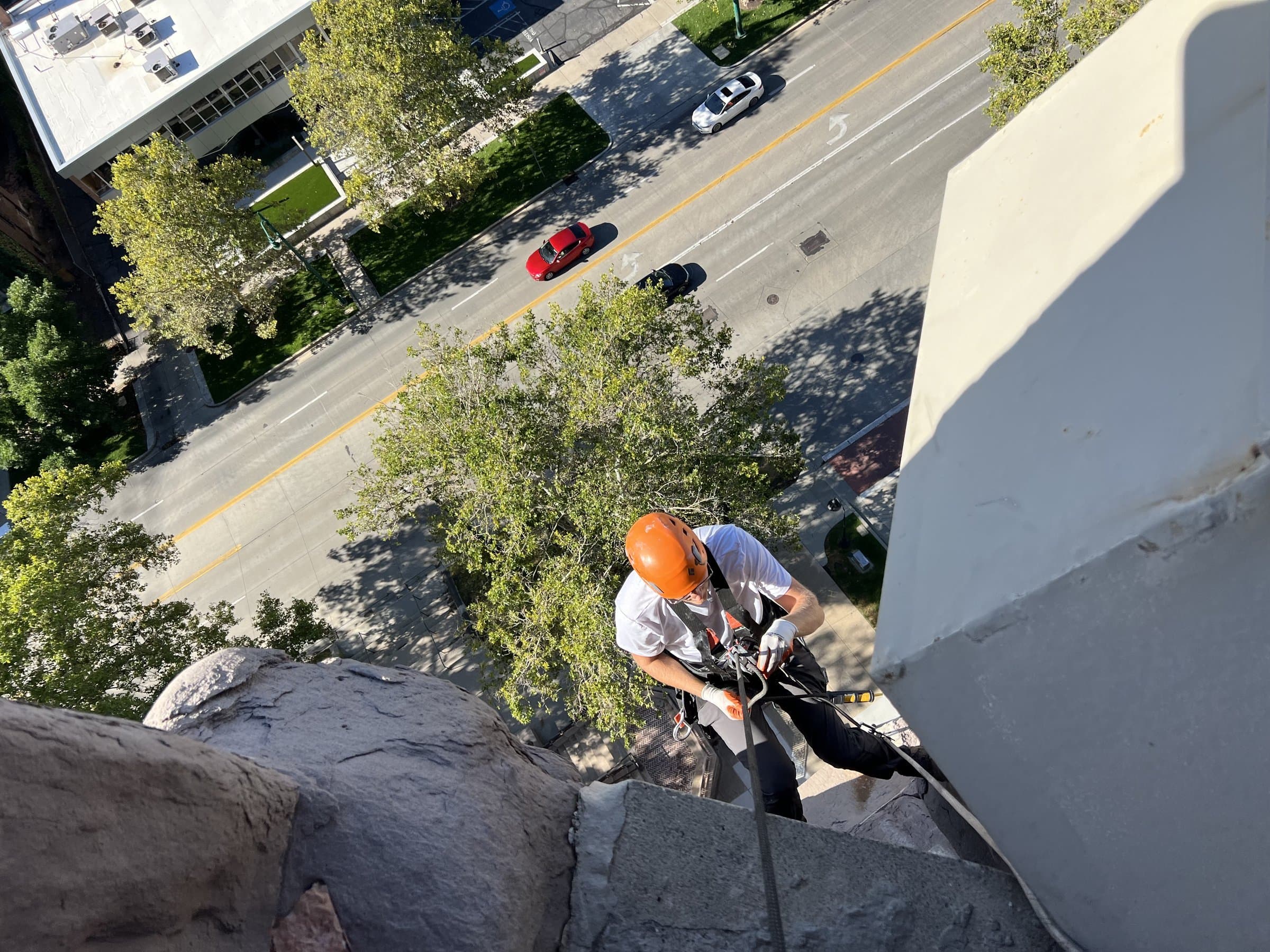
- High-rise / rope-access capacity for elevated buildings
- We finish failed prior jobs—remove old foam and devices
- Two-year written warranty on sealed whole-structure work
- Local eastern WA ownership, backed by a multi-state team
Typical Ephrata jobs start with a phone consultation, then an attic inspection, followed by humane exclusion and optional guano cleanup. Commercial properties can use our commercial bat removal program.
Local bat facts for Ephrata
HistoryLink records that Ephrata incorporated on June 1, 1909, the year it became the seat of the new Grant County, and that the Bureau of Reclamation made it headquarters of the Columbia Basin Project in 1946. Washington OFM puts Ephrata at 9,025 people on April 1, 2026, about 6 percent above the 8,477 counted in 2020. WDFW lists Grant County as a county where the white-nose syndrome fungus is present but no cases of the disease have been confirmed. Under WAC 220-200-100 bats are protected wildlife except when found in or immediately adjacent to a dwelling or other occupied building.
Who to call in Ephrata
- Bat in the house or any bat contact: Grant County Health District, 1038 W. Ivy Ave., Moses Lake, 509-770-5955 (bat page after-hours/weekend line 509-398-2038). Covers Ephrata and all of Grant County.
- Animal calls in city limits: Ephrata Police Department patrol officers (no designated animal control officer), dispatched through MACC, 509-762-1160; 911 for emergencies. Police business office, 121 Alder St. SW, 509-754-2491. Domestic animals and public-safety calls, not attic bats.
- Shelter, lost and found pets: Grant County Animal Outreach, 6725 Randolph Rd. NE, Moses Lake, 509-762-9616.
- Wildlife questions: WDFW North Central Region 2 office, 1550 Alder St. NW, Ephrata, 509-754-4624. WDFW’s Grant County bat rehabilitator: Central Washington Wildlife Hospital, 509-450-7016.
- City Hall: City of Ephrata, 121 Alder St. SW, 509-754-4601.
- Bats living in the attic or walls: A private wildlife control operator. WDFW does not remove bats; it refers homeowners to nuisance wildlife control operators.
Sources
- Grant County Health District – Bats, Animal Bites & Rabies
- City of Ephrata – Animal Control
- City of Ephrata – Police FAQ (no designated animal control officer)
- City of Ephrata – Police Department
- Grant County Sheriff – Animal Control Unit and Grant County Animal Outreach
- HistoryLink – Ephrata: Thumbnail History
- HistoryLink – City of Ephrata is incorporated (June 1, 1909)
- HistoryLink – Fire devastates downtown Ephrata (March 13, 1910)
- Washington State DOH – Bats tested for rabies by county, 2021–2025 (PDF)
- Washington State DOH – Rabies activity in Washington
- WDFW – White-nose syndrome in bats (county status, rehabilitators)
- WDFW – Regional offices (North Central Region 2, Ephrata)
- WDFW – Living with wildlife: Bats
- Washington OFM – April 1, 2026 population of cities, towns and counties
- WAC 220-200-100 – Wildlife classified as protected
Ephrata bat removal FAQ
Ephrata & Grant County
- Moses Lake bat removal
Grant County / Columbia Basin
- Wenatchee bat removal
Wenatchee Valley / Chelan County
- East Wenatchee bat removal
Wenatchee Valley / Douglas County
- Ellensburg bat removal
Kittitas Valley / Kittitas County
- Yakima bat removal
Yakima Valley
- Spokane bat removal
Spokane metro
- Kennewick bat removal
Tri-Cities / Benton County
- Pasco bat removal
Tri-Cities / Franklin County
- All service areas
Eastern Washington hub
- Why us
Proof points & team
- How we work
Process steps
- Warranty
Two-year coverage
- FAQ
Common questions
Bat problems in Ephrata? Let's talk.
Humane exclusion for Ephrata and the surrounding Grant County seat / Columbia Basin. Two-year written warranty on whole-structure work. Same-day often available across the 509.